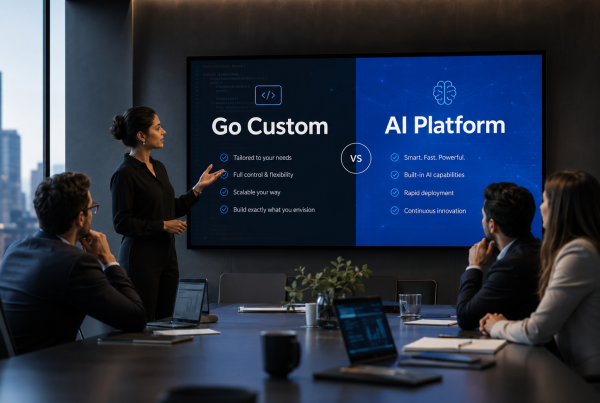

AI-powered marketing works when it’s built as a system, but most businesses never build the system. They add a chatbot. Switch on smart bidding. Subscribe to an AI writing tool. Then wonder why the results don’t match the promise. The problem isn’t the tools. The problem is that tools without a system are just expensive tasks.
The businesses seeing real, compounding results from AI-driven marketing aren’t running more tools. They’re running connected systems where data, content decisions, and spend optimization feed each other automatically. One layer informs the next. The whole thing improves with every cycle. That’s a fundamentally different thing from what most teams are doing.

This article breaks down how the core mechanisms actually work, what businesses experience when they make the shift from manual to AI-driven systems, and what it takes to build something that doesn’t just perform once but gets better over time. No hype. Just the mechanics.
What AI-driven marketing actually is (and what it isn’t)
Most businesses already use some form of marketing automation. Scheduled emails, drip sequences, social posts queued up on Monday morning. That’s not AI marketing. That’s a calendar with triggers. The distinction between automation and genuine AI-powered marketing comes down to one thing: does the system react to rules you set in advance, or does it respond to real-time behavior and data signals?
Real AI marketing predicts. It uses behavioral data, purchase history, conversion patterns, and audience signals to make decisions your team would never have the bandwidth to make manually. A rule-based system sends a follow-up email three days after sign-up. An AI-driven system sends the right message, to the right segment, at the statistically optimal time, with content that adapts to where each person sits in the buying journey.
Four mechanisms sit underneath every effective AI marketing system: personalization engines, predictive analytics, automated bidding, and content generation. Each one delivers value on its own. But connected into a single system, the output compounds. Personalization data improves bidding. Bidding performance data sharpens content decisions. Content performance feeds the personalization engine. That loop is what separates a system from a toolset.
How personalization and predictive analytics work in practice
AI-enabled personalization
Personalization has been a marketing buzzword for years, but what it means in an AI context goes far beyond adding a first name to an email subject line. Modern AI-enabled personalization works by segmenting audiences based on behavioral signals, then serving dynamic content that adapts to where someone sits in the buying journey. An eCommerce brand, for example, can automatically show cold prospects a brand story and introductory offer on the homepage, while returning buyers see restocked favorites and loyalty rewards. The same website. Different experiences. No manual intervention required.
Platforms like HubSpot AI and Salesforce Einstein have made this accessible inside existing workflows. Send-time optimization, dynamic email content, and behavior-based triggers are now standard features rather than enterprise-only capabilities. The practical result is higher engagement rates and lower unsubscribe rates, because the content people receive is relevant to what they’re actually doing, not just when they signed up. For teams that need a succinct primer on how AI fits into modern marketing practice, see understanding AI in digital marketing.
Predictive marketing in action
Predictive analytics takes this further by forecasting outcomes before spend is committed. Modern predictive marketing models can estimate churn probability, purchase likelihood, lead-to-close conversion rates, and expected campaign performance. That’s the shift from reactive marketing, reviewing last week’s numbers and adjusting, to anticipatory marketing: deploying budget where outcomes are already statistically likely. It changes the entire posture of how a marketing team operates. Instead of asking “what worked?”, the question becomes “where should we go next?”
Automated bidding and content generation at scale
Google’s Smart Bidding processes over 70 million signals per auction in real time: device, location, time, purchase history, user behavior, and more. No human media buyer can process that at auction speed. AI systems adjust bids for every single impression based on conversion likelihood. According to Google’s own performance data, advertisers using Smart Bidding strategies like Target CPA and Target ROAS typically see 15 to 30 percent better performance than manual bidding. Reduced cost-per-acquisition, higher ROAS, and less wasted spend are the standard outcomes when the system has clean conversion data to learn from. For a practical walkthrough of how automated bidding works in Google Ads, consult this AI-powered automated bidding guide.
That last point is critical: smart bidding isn’t set-and-forget. It needs quality conversion data as its input. Feed it noise and it optimizes for the wrong thing. Feed it clean, well-structured conversion tracking and it gets sharper every week. The system is only as good as what you put into it.
Generative AI for marketing has a similar nuance. Tools like Jasper AI can produce ad copy, email subject lines, blog drafts, and social posts from brief inputs, and with trained brand voice settings, the output stays on-brand consistently. The practical distinction is this: use AI as a first-draft engine that a human refines, and you get speed without sacrificing quality. Use it as a publishing machine with no human review, and you get volume without substance. The former compresses your content operation significantly. The latter creates noise that erodes trust over time. For teams evaluating options, a useful resource is a curated list of AI tools for marketing.
What changes when businesses adopt a connected AI marketing strategy
The manual campaign reality is recognizable to most marketing teams. Ad budgets split across Google and Meta with no unified view of performance. Content created reactively, without performance data to guide it. Sales teams following up on unqualified leads because there’s no scoring system in place. Weeks of coordination before a campaign can go live. This is the baseline most businesses are running from, and it’s expensive in both time and money.
Consider a mid-size B2B company running Google Ads, LinkedIn campaigns, and weekly email blasts, all managed separately, none connected to each other or to the CRM. The Google team optimizes for clicks. The LinkedIn team optimizes for impressions. The email team sends to the full list. Nobody knows which channel actually drives pipeline. Decisions get made on gut feel and last-click attribution, which means budget goes to whatever looks good on a single-channel dashboard, not where it’s actually working.
When an integrated AI marketing strategy replaces that fragmented approach, the change is structural. Leads are scored before they hit the sales team, so reps spend time on prospects who are actually ready. Ad spend adjusts daily based on performance signals across channels, not weekly based on a report someone built in a spreadsheet. Content gets produced faster, tested automatically, and iterated based on what’s converting.
The evidence is specific. A European telecom company that adopted a gen AI-powered personalization engine reported 10 percent higher engagement and action rates compared to non-personalized campaigns. A major retailer using an integrated AI marketing stack generated $400 million in value from pricing improvements and $150 million from AI-enabled offers in a single year. The pattern holds: connected systems outperform disconnected tools.
How end-to-end AI marketing systems get built for growing businesses
Most businesses adopt AI tools one at a time. A chatbot here. An AI writing tool there. Smart bidding switched on without clean conversion tracking underneath it. The tools don’t talk to each other, data stays siloed, and the efficiency gains that were promised never fully materialize. This isn’t a technology failure. It’s an architecture failure. The tools work. The absence of a system connecting them is what doesn’t.
Building an AI-powered marketing system that actually compounds requires starting with business goals, not tool selection. You map the full customer journey first: where are leads coming from, where do they drop off, what does a qualified lead look like, and what does the conversion path actually look like versus what the team assumes. Only then can you build the AI infrastructure that addresses the real gaps, automation where tasks are repetitive, personalization where content needs to adapt, predictive scoring where qualification is manual, and performance marketing where spend decisions need real-time data.
This is the model Strivesync operates from. Rather than plugging in isolated tools, Strivesync builds integrated marketing and sales systems where AI automation, paid media, content, and web conversion work as one engine. AI agents handle lead qualification and customer interactions. Performance campaigns across Google and Meta are optimized in real time with clean conversion tracking underneath them. Content systems are designed to convert, not just publish. For a growing business in the UAE or anywhere competing in a fast-moving digital market, this is what end-to-end AI-powered marketing actually looks like in practice, not as a concept.
Measuring whether it’s working: the KPIs that matter
Engagement metrics are not ROI metrics. Click-through rates, open rates, and follower counts tell you something about attention. They don’t tell you whether the AI investment is generating revenue. The metrics that actually reflect AI marketing performance are ROAS, cost per acquisition, lead-to-customer conversion rate, time saved on manual tasks, and customer lifetime value. Platforms including McKinsey and Salesforce have documented conversion rate improvements of up to 30 percent and campaign ROI gains of 20 to 30 percent from AI-optimized campaigns, but those numbers only become meaningful if you established a pre-AI baseline to compare against. For frameworks on how to assess campaign ROI specifically for AI-driven efforts, refer to this practical guide on measuring ROI in AI campaigns.
Isolating what the AI is actually contributing requires two approaches. First, A/B testing with control groups: run AI-driven campaigns alongside standard campaigns targeting similar audiences, and measure the difference in outcomes directly. Second, pre/post baseline comparisons: document your CPA, ROAS, conversion rates, and campaign velocity before implementation, then track the same metrics after. For businesses running AI across multiple channels, multi-touch attribution models are worth building, because last-click attribution will systematically under-credit the channels that do awareness and consideration work earlier in the funnel.
One practical note: the first 30 to 60 days after implementation should be a measurement sprint, not a scaling sprint. Get your attribution clean. Verify your conversion tracking. Confirm the data flowing into your AI systems is accurate. Scaling spend on top of bad data is one of the fastest ways to waste a marketing budget. Get the measurement right first, then scale what you know is working.
Build the system, not the list
AI-powered marketing works when it’s built as a system. Personalization, predictive analytics, automated bidding, and content generation each deliver value in isolation. Connected and feeding each other, they compound. That’s the difference between incremental improvement and a marketing operation that gets measurably better every month.
Building this from scratch is hard. It requires clean data, the right platforms, an understanding of how each layer feeds the next, and the operational discipline to measure before you scale. Most teams don’t have all of that in place, and figuring it out through trial and error is expensive. Working with an agency that has already built these systems is the faster path to results that compound.
The practical starting point is simpler than it sounds. Assess where your current marketing is fragmented: where decisions are made manually that could be automated, where ad spend has no real-time feedback loop, where content is created without performance data guiding it. Pick the highest-impact AI use case first and start there. Not everywhere at once. One well-built system beats ten disconnected tools every time.