
This is the exact pattern Strivesync sees with almost every new client. The sales process runs entirely on human speed and human memory, and both have limits. Fix that one thing, and everything downstream changes: more booked calls, more closed deals.
Most businesses don’t lose leads because of a bad product or a weak offer. They lose them because nobody followed up fast enough. A prospect fills out a form on a Monday morning, and by the time someone checks the inbox, drafts a reply, and hits send, it’s Tuesday afternoon. The prospect has already talked to two other vendors and booked a call with one of them.
This article is a practical walkthrough of how to use AI agents to automate sales and follow-up, covering the full system from lead intake and instant response to qualification, CRM updates, and multi-step follow-up sequences. No technical background required.
Why Leads Go Cold Before You Even Pick Up the Phone
The math behind the five-minute rule
The 2026 Optifai Pipeline Study, covering nearly 1,000 B2B companies, found that businesses responding to inbound leads in under five minutes close at a 32% rate. Those responding after 24 hours close at 12%. Leads contacted within five minutes of inquiry are up to 21 times more likely to qualify than those contacted after 30 minutes. That’s not a marginal difference. It’s a different category of business.
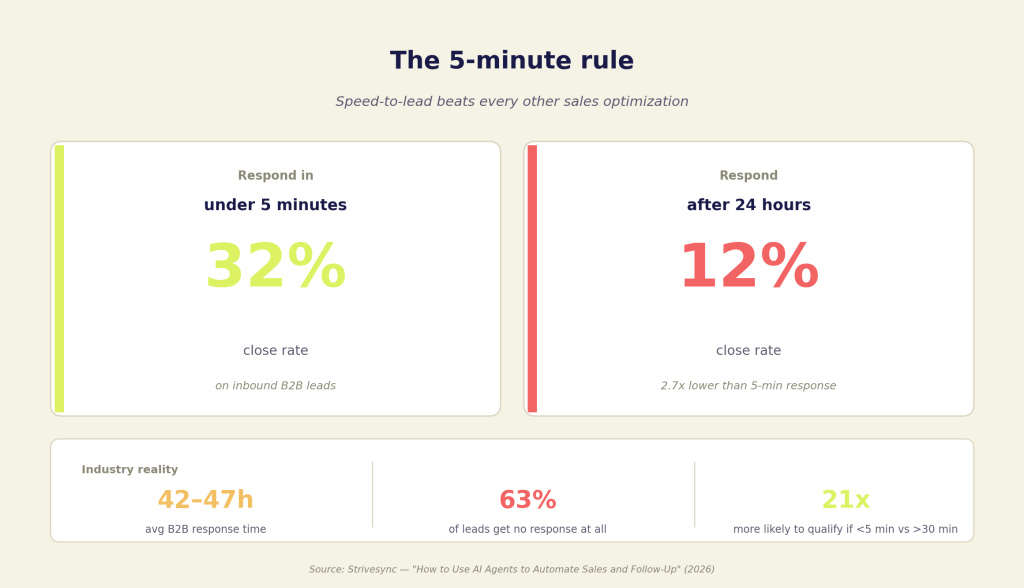
Most businesses are nowhere near that five-minute window. The average B2B response time sits at 42 to 47 hours. And in many cases, 63% of inbound leads receive no response at all. This isn’t a motivation problem. It’s a structural one.
What manual follow-up actually looks like
Here’s the real sequence: a lead comes in, gets logged somewhere (maybe), lands on someone’s task list, and gets picked up when there’s a gap in the day. By then, the prospect’s attention has moved on. The problem isn’t that your team is lazy. It’s that the process requires a human to be available, attentive, and quick, all at once, all day long.
AI sales agents don’t replace the salesperson. They handle the window between lead arrival and human conversation, so that window stops costing you deals. The rep still closes. The agent handles everything that happens first.
How to Use AI Agents to Automate Sales and Follow-Up: What They Actually Do
The five jobs they handle so you don’t have to
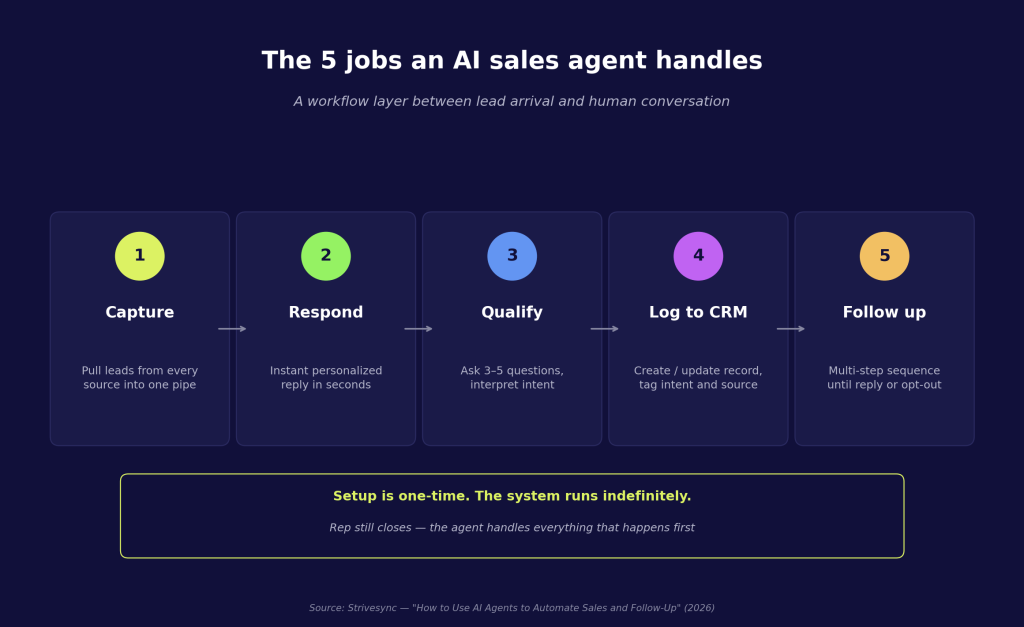
In plain terms, AI sales agents handle five things: capturing incoming leads from any source, sending an immediate personalized response, asking qualification questions and interpreting the answers, logging everything into the CRM, and running a multi-step follow-up sequence until the prospect responds or opts out. That’s the full loop, running without anyone watching it.
To be clear about what these systems are not: they are not cold callers, and they are not replacing account executives. They are a workflow layer that handles repetitive, time-sensitive middle work, the kind that burns hours and falls through cracks when left to humans alone. Think of them as a sales development rep who never sleeps, never forgets, and never has a slow Monday.
How these systems get built for real businesses
Most business owners don’t need to become AI builders. Agencies like Strivesync design and deploy these automated sales workflows as part of an integrated marketing and sales system. The business owner defines the rules: who qualifies, what a hot lead looks like, when to hand off to a human. The system runs those rules consistently, every time, for every lead. The setup work happens once. The system works indefinitely.
Step 1: Capture Every Lead and Reply Before Your Competitor Does
Connect your lead sources to a single intake point
AI agents sit at the top of the funnel by integrating with wherever leads come from: web forms, Meta and Google ad landing pages, WhatsApp, email inboxes, or direct messages. Tools like n8n, Zapier, or native CRM integrations route these leads into a single workflow in real time. No lead falls through because no one’s watching. Every submission, regardless of source or time of day, triggers the same reliable process.
This matters more than most businesses realize. A lead that comes in at 11 PM on a Friday used to wait until Monday morning. With an automated intake point connected to an AI agent, that lead gets a response within seconds, while their interest is still active.
Set up the instant response trigger
Once a lead hits the intake point, the AI agent fires an immediate reply. Done right, a good instant response feels like onboarding, not an interrogation. It acknowledges the inquiry and sets a clear expectation, something like “I’ll ask you a couple of quick questions to point you in the right direction”, without pretending to be human. The goal at this stage is to keep the prospect in the conversation window before their attention drifts. A reply that arrives in under two minutes signals professionalism. It also wins the race.
Step 2: Qualify Leads and Update Your CRM Without Lifting a Finger
Design qualification questions that do the sorting
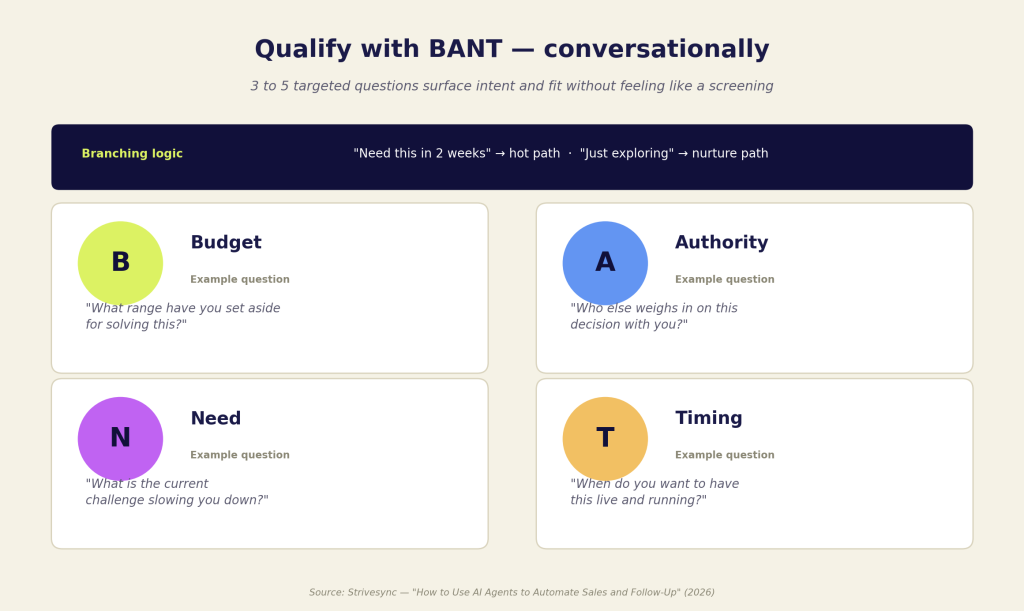
The AI agent carries the conversation forward by asking three to five targeted questions: budget range, timeline, current challenge, team size, or whatever qualifiers matter for your business. The questions can branch based on answers. A lead who says “I need this in two weeks” gets a different follow-up path than one who says “just exploring for now.” The business owner defines the qualifying criteria. The agent runs the logic, every time, without variation.
Good qualification questions follow the BANT structure: budget, authority, need, and timing. That said, you don’t need to be rigid about it. The goal is to surface intent and fit. Frame questions conversationally, and the qualification feels seamless, the prospect experiences it as getting help, not being screened.
Automate CRM record creation and tagging
Once the qualification exchange is complete, the AI agent creates or updates the CRM record automatically, tagging the lead by qualification status, intent level, and source. Hot leads get flagged for immediate human outreach. Cooler leads roll into a nurture sequence. Platforms like HubSpot, Salesforce, and Pipedrive all support this via native integrations or middleware tools like n8n. The sales rep opens their CRM and sees a pre-qualified, pre-logged pipeline, not a raw inbox full of unread messages. That shift alone saves hours every week. For practical guidance on consistent lead follow-up and CRM hygiene, see best practices for lead follow-up.
Step 3: Build an AI Follow-Up Automation Sequence That Runs on Autopilot
The sequence structure that actually converts
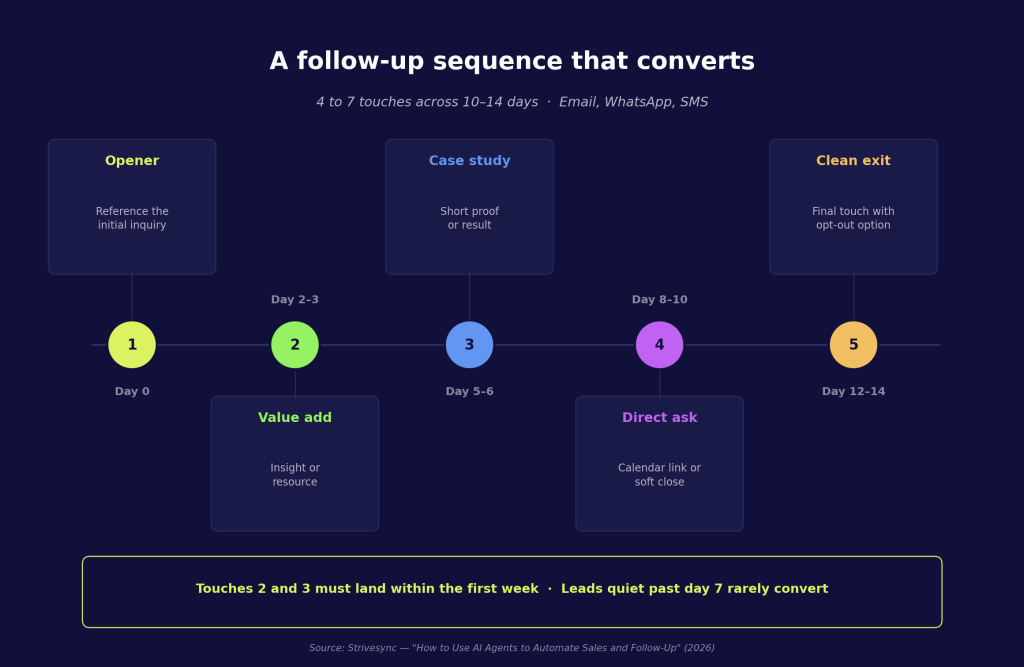
A practical automated outreach sequence runs four to seven touches across ten to fourteen days, using a mix of channels based on your audience: email, WhatsApp, or SMS. Each touch serves a distinct purpose. The opener references the initial inquiry. The second touch adds value with a relevant insight or resource. The third shares a short case study or result. The fourth offers a direct calendar link or asks a soft closing question. The final touch gives a clean exit with an opt-out option.
Timing matters as much as content. Touches two and three should land within the first week, when intent is highest. Leads that go quiet past day seven rarely convert without a targeted re-engagement campaign, in practice, most of those opportunities are simply gone. Most businesses leave this entirely to chance. A well-built AI follow-up automation sequence removes chance from the equation.
Keeping messages personal without writing each one manually
Generative AI for sales handles personalization using the data collected during qualification. The prospect’s name, company, stated challenge, and timeline feed into the message templates, making each follow-up feel specific rather than canned. The business owner writes or approves the master templates once, and the system handles delivery, timing, and variation based on each lead’s profile. You’re not sending the same message to everyone. You’re sending the right message to each person, at the right time, without doing it manually.
This is also where autonomous sales agents earn their keep, by running the full outreach cycle without requiring a human to review each step. Some teams also deploy an AI SDR model, where the agent handles early-stage prospecting and nurturing before handing qualified leads to a human rep. If you want a practical walkthrough on how to generate a personalized outreach sequence with AI, there are step-by-step guides that map this exact flow. Either approach keeps your pipeline moving around the clock.
How to Know the System Is Working: The Numbers to Watch
The metrics that reveal real performance
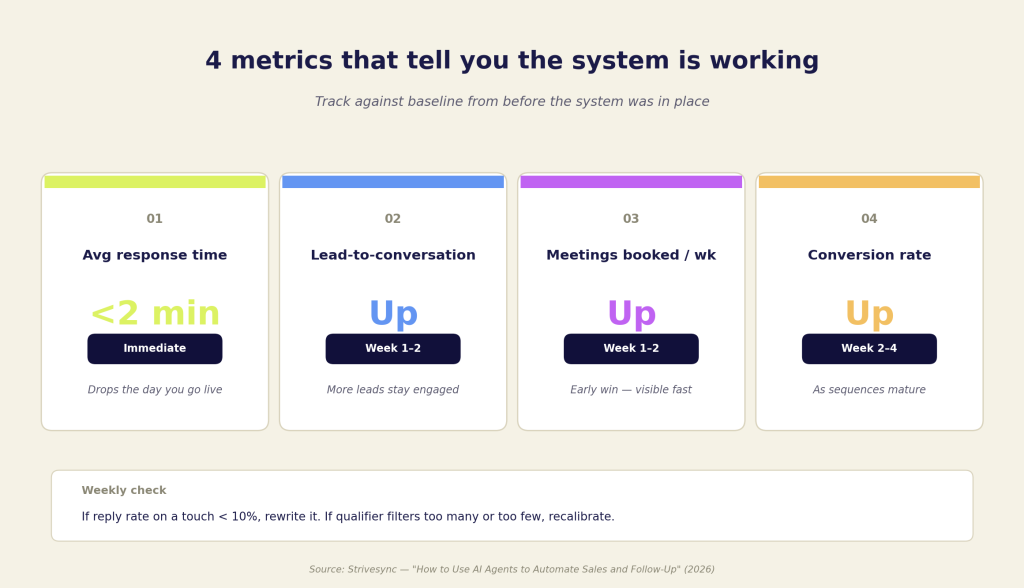
Four numbers tell you whether the system is doing its job. First, average response time: this should drop to under two minutes once the system is live. Second, lead-to-conversation rate: how many leads get into an active exchange with the agent. Third, meetings booked per week. Fourth, conversion rate from lead to paying client. Track all four against your baseline from before the system was in place. Most businesses see the clearest early wins in response time and meetings booked, with conversion improvements following in weeks two through four as the sequences mature.
When to adjust versus when to scale
Check open and reply rates on your follow-up sequences weekly for the first month. If reply rates on a specific touch fall consistently below 10%, rewrite that message. If the qualification questions are filtering out too many leads or too few, recalibrate the criteria. Once the sequence is converting consistently, that’s your signal to increase lead volume into it, not before. Scaling a broken sequence just wastes more budget. Scaling a working one is how growth becomes predictable.
The System Is Simpler to Build Than You Think
Here’s how the full workflow runs: a lead comes in, the AI responds instantly, qualifies the prospect, logs everything to the CRM, and runs a personalized follow-up sequence until the prospect books a call or steps out. The salesperson shows up to a pipeline that’s already warm. No leads lost to slow follow-up, no hours spent on manual outreach, no wondering what happened with last week’s inquiries.
Building this doesn’t require a development team or months of setup. It requires clear thinking about how your sales process should actually work, and the right partner to wire it together. Strivesync builds these AI-driven sales systems as part of end-to-end marketing and sales engagements, so the intake, qualification, CRM logic, and follow-up sequences all work as one connected engine from day one.
If you want to learn how to use AI agents to automate sales and follow-up in your own business, that’s exactly the kind of system Strivesync deploys. How many leads did slow follow-up cost you last month? That number is worth knowing before it gets any bigger.