Too many businesses don’t have a lead generation system. They have a collection of disconnected activities. An ad here, a landing page there, a follow-up email that goes out when someone remembers to send it. The result is a pipeline that looks full one month and empty the next, with leadership unable to explain why either happened.
This is a solvable problem, but the solution isn’t another campaign. It’s infrastructure. A well-built lead generation system is a connected set of components that work together to bring in strangers, turn them into prospects, and move them toward a buying decision, without starting from scratch every time a campaign ends. Once it’s running, you optimize it. You rarely need to tear it down and rebuild from zero.
This guide breaks down every component, how they connect, which tools power them in 2026, and what numbers tell you the whole thing is actually working.
What a lead generation system actually is
A campaign is a one-time push. You spend money, get leads, the campaign ends, and the leads stop. A system is something you build once and optimize continuously. It keeps running whether you’re watching it or not. The goal isn’t volume of leads. It’s a predictable, repeatable flow of qualified prospects.
Most businesses treat lead generation as an event: launch a promotion, run some ads, see what comes in. A lead generation system treats it as infrastructure. Each part connects to the next. Traffic feeds capture. Capture feeds nurture. Nurture feeds qualification. Qualification feeds conversion. Nothing is a standalone effort, and nothing falls through a gap because a rep was too busy to follow up manually.
The word “system” matters because it changes how you think about the problem. You stop asking “how do we get more leads this month?” and start asking “what does each stage of our pipeline produce, and where is it breaking down?” That shift in framing is what separates businesses with predictable revenue from businesses that are always guessing.
The five components every pipeline engine needs
Lead capture system: landing pages, forms, and traffic sources
Traffic is the entry point: paid ads, organic search, social content, partnerships, and referrals. Capture is what happens when that traffic arrives. Landing pages, lead magnets, forms, and chat tools convert anonymous visitors into known contacts. The key is low friction at the entry point while collecting enough data to qualify the lead later.
A form that asks for twenty fields will kill your conversion rate. A form that asks for only three fields will fill your CRM with unqualified contacts who waste your sales team’s time. The sweet spot is four to six fields, enough to score fit, not enough to scare off a serious prospect. Progressive profiling, where you collect additional data across multiple touchpoints, is a practical way to get both.
B2B lead generation landing pages convert at a median of around 4% across industries in 2026, but the range is wide. Legal services land near 7.4%. B2B SaaS sits closer to 1.1%. Knowing your industry baseline tells you whether a capture problem is your offer, your traffic quality, or your page itself. For more on how landing pages perform across industries, see landing page conversion rate benchmarks for 2026.
Nurture and qualify: separating buyers from browsers
Most leads aren’t ready to buy when they first show up. Nurture sequences, email drips, retargeting ads, and personalized content matched to funnel stage, keep them engaged until they are. A strong nurture sequence isn’t a broadcast newsletter. It’s a logical progression: email one frames the problem, email two builds trust with a case study, email three addresses objections, and email six invites them to a conversation. Each message builds on the last.
Qualification layers on top of nurture. Through lead scoring based on fit signals (company size, role, industry) and behavior signals (pricing-page visits, demo requests, repeated engagement), the lead scoring and nurturing workflow separates high-intent prospects from those who are just browsing. Research consistently shows that a combined fit-and-intent scoring model outperforms scoring on behavior alone. A VP at a 500-person SaaS company who visited your pricing page three times this week is a different conversation than a solo freelancer who downloaded your ebook once.
Convert: closing the loop with sales
Conversion is where qualified leads meet your sales team or a self-serve flow. This includes CRM handoff, automated meeting booking, and rep notification when a lead crosses a score threshold. The conversion component also feeds data back into the rest of the system. Closed-won data tells you which lead sources produce real revenue. That information improves targeting, scoring models, and nurture content over time. Without this feedback loop, you’re optimizing in the dark.
Why running campaigns without a lead generation system is a trap
A campaign produces leads. But campaigns can also feed longer-term pipeline, if they’re connected to a capture and nurture infrastructure. Without that infrastructure, when the campaign ends, so does the momentum. You’re always starting close to zero. A system compounds. Every piece of content, every nurture sequence, and every scoring refinement makes the whole machine more effective over time. The leads you nurture today convert next quarter. The data from closed deals improves your targeting next year.
Businesses with systems can forecast pipeline. They know how much traffic produces how many leads, how many leads qualify, and how many qualified leads close. That’s not magic; it’s the result of having all five components connected and measured. Businesses running one-off campaigns can’t forecast anything because there’s no consistent input or output to measure against. Every month is a new guess.
The compounding math matters. Each optimization pass makes the system more efficient. Lower cost per lead, higher lead-to-opportunity rate, shorter sales cycles. None of that is available to businesses running disconnected campaigns because there’s no stable baseline to improve against.
How the components connect from first click to close
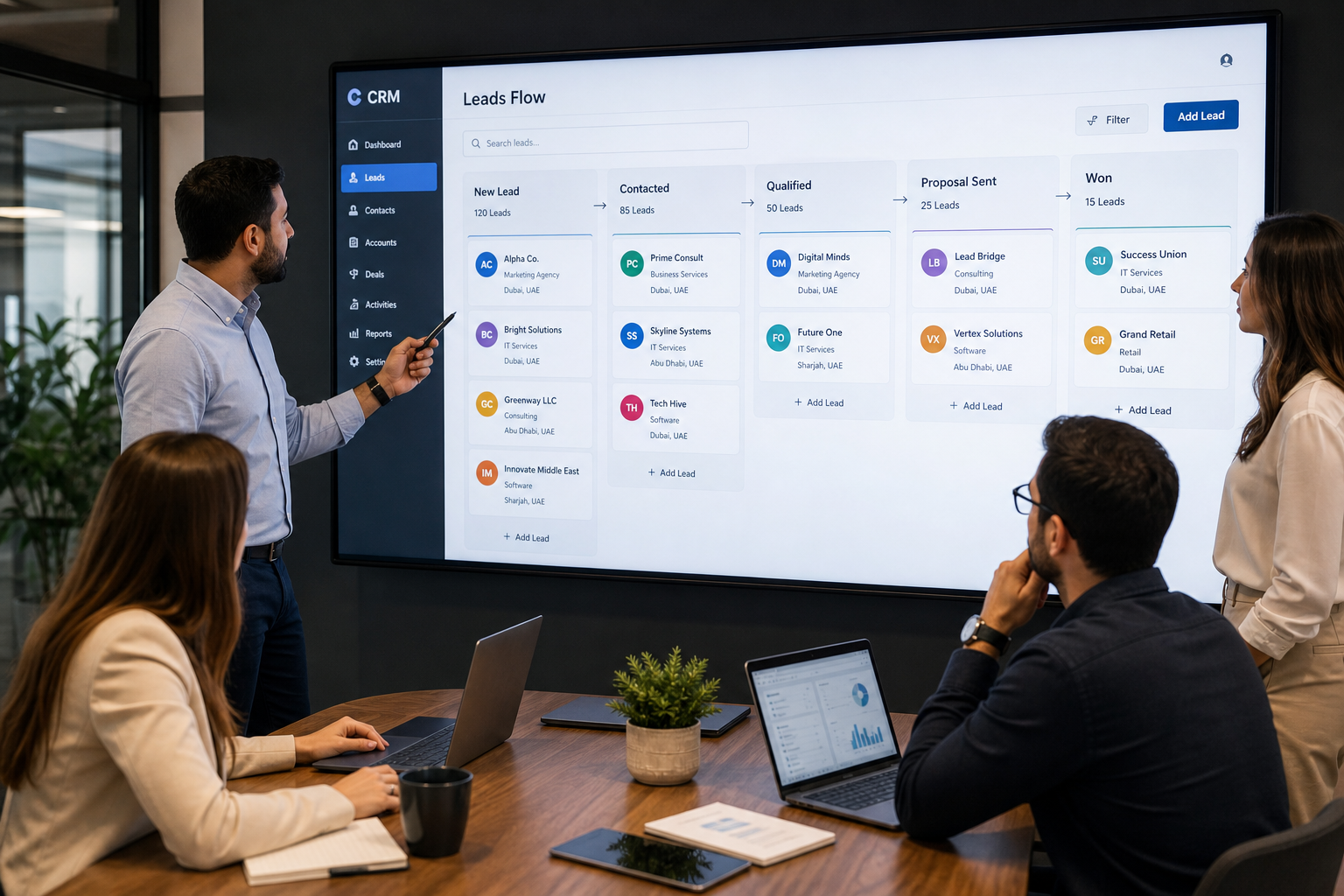
Here’s what the flow looks like in practice. A prospect clicks an ad and lands on a capture page. They fill out a form, enter the CRM, and get scored based on firmographic fit and behavior. If they’re not yet sales-ready, they enter a nurture sequence. After engaging with a case study three days later, their score crosses a threshold. The system triggers an automated sales alert, assigns a rep, and sends the prospect a meeting link. The rep gets full context: what the prospect looked at, when, and how many times. No manual decisions. No leads falling through gaps.
A frequent failure point isn’t the tool stack. It’s the gap between marketing and sales. Leads get handed off too early or too late. Score thresholds don’t reflect what sales actually considers qualified. Nurture content doesn’t match where the lead is in their decision process. Building a lead generation system that works requires both teams to agree on definitions, handoff rules, and what “qualified” actually means in practice, not just in theory.
Tools that power a modern lead management system in 2026
For smaller B2B teams, the most practical combination in 2026 is an outreach and database tool (Apollo.io covers both at around $49 to $79 per user per month), a CRM with native marketing automation (HubSpot handles capture, nurture, scoring, and pipeline in one platform), and a form or landing page builder connected to both. LinkedIn Sales Navigator supplements prospecting for B2B outbound at around $99 to $149 per user per month. Routing and enrichment can be handled through Clay or native CRM workflows if you want more customization without enterprise pricing.
- Apollo.io: prospecting database plus email sequencing in one tool, well-suited for SMBs that want fast time-to-value
- HubSpot: capture, nurture, scoring, and pipeline management under one roof, with a usable free tier for early-stage teams
- LinkedIn Sales Navigator: a reliable source for current job titles and decision-maker targeting in B2B
- Clay: flexible enrichment and workflow automation for teams that want a custom outbound engine
Getting all the components of a lead gen software stack to work together cleanly takes real time and iteration. For businesses that want the full marketing automation stack built and running without managing a dozen integrations, Strivesync builds these systems end-to-end: paid media, capture pages, CRM setup, AI-powered lead qualification, and nurture sequences connected as one engine. That’s the difference between having tools and having a system that actually produces pipeline.
Benchmarks that tell you if your lead generation system is working
Three metrics matter most, and each one diagnoses a different part of the pipeline.
Conversion rate from traffic to captured lead. A healthy B2B range is 1% to 5% depending on offer type and industry, with a median closer to 4% for optimized lead-gen pages. If you’re consistently below 1%, the problem often sits with the offer or the traffic quality rather than the form design alone, though it’s worth auditing all three before drawing conclusions.
Cost per lead by channel. LinkedIn typically runs $100 to $150 CPL for B2B campaigns in competitive markets like the UAE, with landing page campaigns pushing toward $150 to $250. Paid social runs cheaper but often produces weaker quality leads that drag down your lead-to-opportunity rate downstream.
Lead-to-opportunity rate. A working baseline for B2B sits between 15% and 30%. Below 10% signals a qualification problem, not a volume problem. More leads won’t fix it; a sharper scoring model will.
Benchmarks give you a baseline, not a target. What matters more is the trend inside your own system. Is your lead-to-opportunity rate improving quarter over quarter? Is your cost per lead dropping as your scoring model gets more accurate? Strong systems generate better leads at a lower cost as they mature, and that improvement only happens if you’re measuring consistently and using the data to refine what’s already running.
Build it once, optimize it continuously
A lead generation system isn’t a tool. It’s not a campaign. It’s the infrastructure your pipeline runs on. Build the five components. Connect them. Measure what matters. Refine as you go.
Most businesses skip this because they want leads now. They run a campaign, see some results, and call it marketing. Then the results stop and they run another campaign. That cycle is expensive, exhausting, and leaves you no better positioned six months from now than you are today. The businesses that break out of it invest in building a system once and letting it compound.
If you’re a UAE business looking for predictable pipeline, Strivesync builds exactly this: full-stack lead generation systems where paid media, capture, nurture, AI qualification, and CRM handoff all work as one connected engine. Every lead is scored, every qualified prospect reaches your sales team with full context, and every channel is tracked so you know what’s driving results. The goal isn’t activity. It’s a pipeline that shows up whether you’re watching it or not. Learn more about how Strivesync builds these systems for businesses across the UAE.