Brazilian businesses running on manual processes and scattered tools are losing ground fast. The gap isn’t theoretical: it shows up in response times, conversion rates, and the cost to acquire each new customer. While one business answers leads the next morning, a competitor’s AI agent already had a conversation, scored the prospect, and booked a call at 11 PM. The race isn’t between big companies and small ones. It’s between businesses that have integrated AI into their operations and those still waiting to see how it plays out.
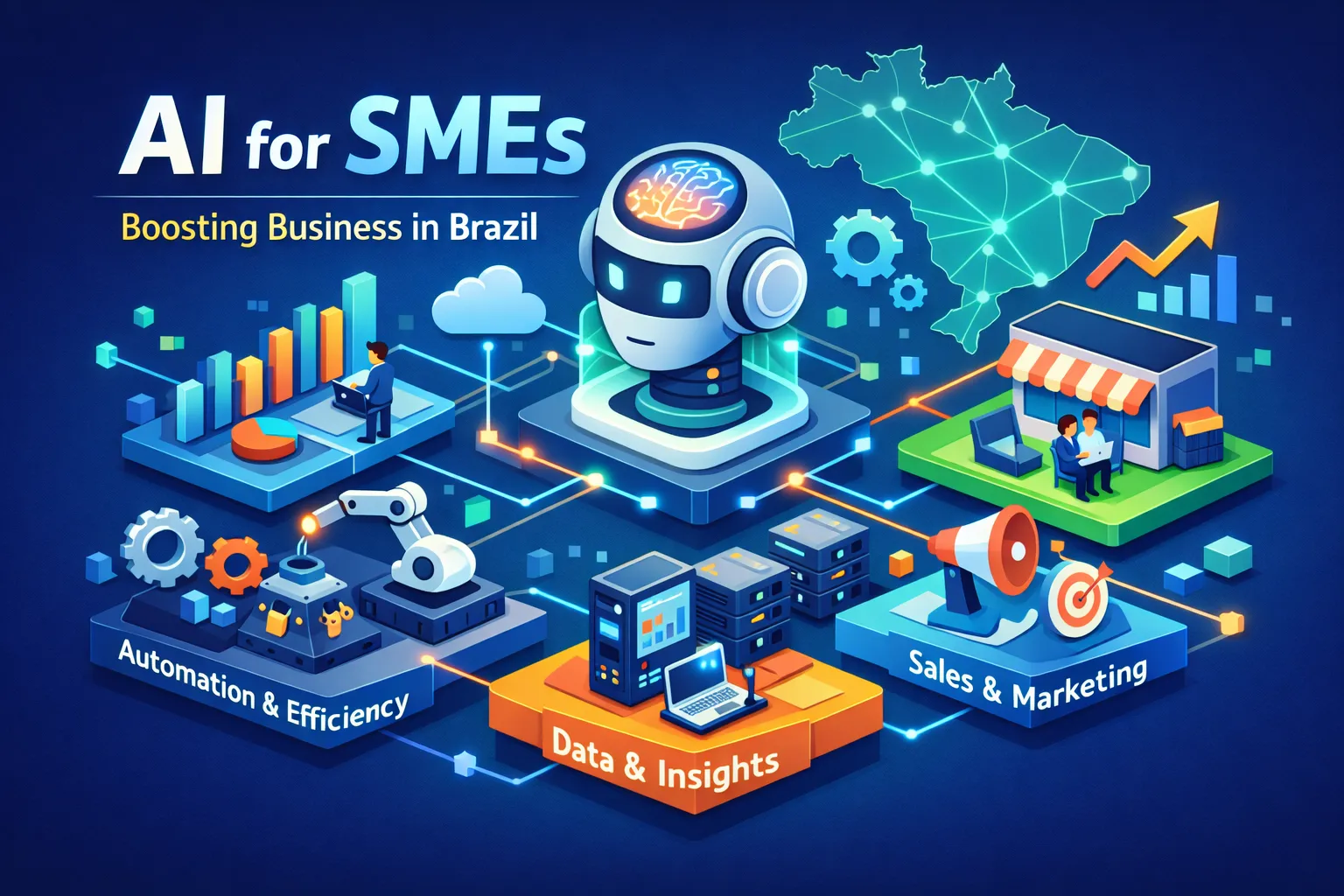
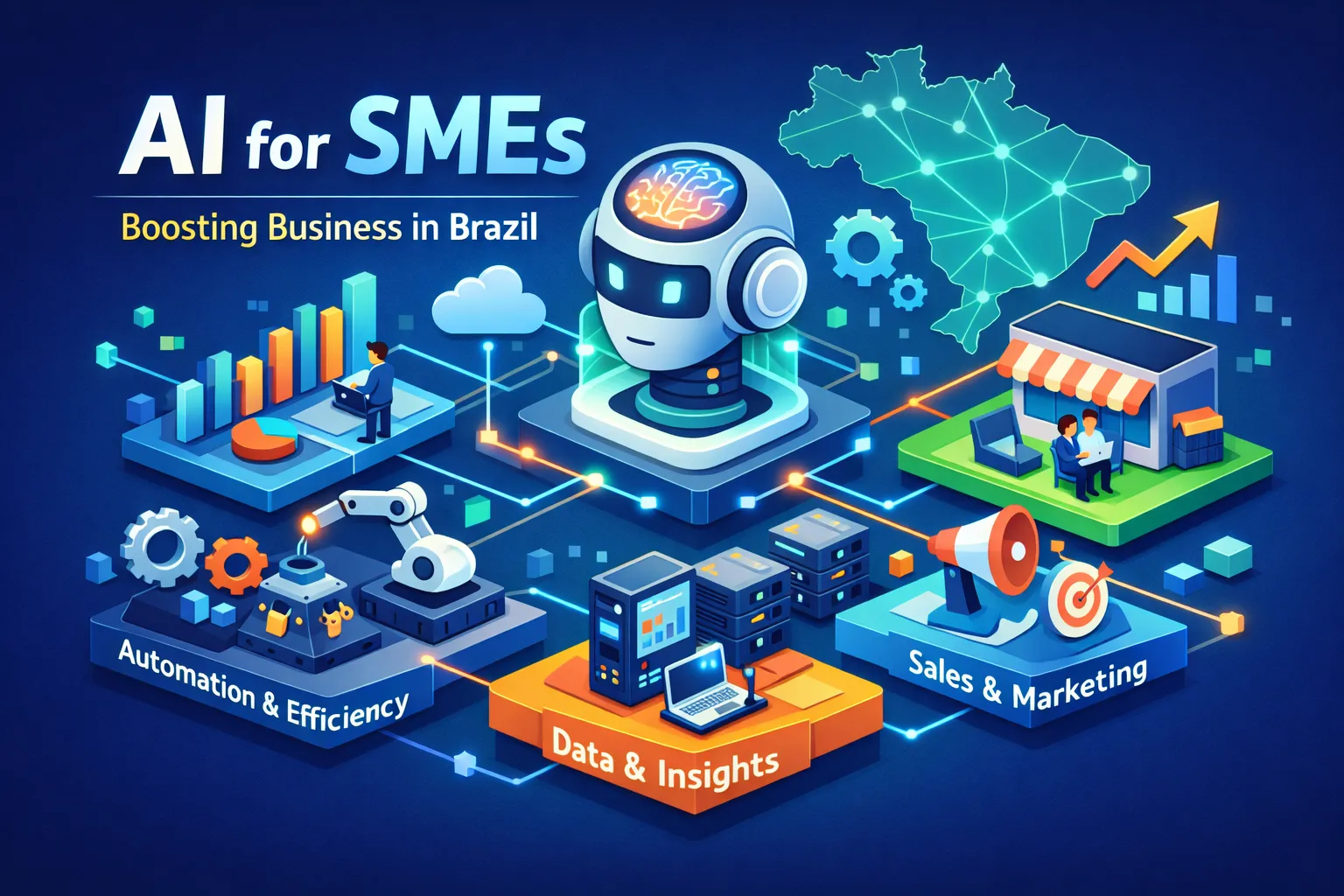
This article breaks down the AI applications (AI for SMB) delivering the highest real-world impact for Brazilian small and medium businesses right now. Specialized agencies building integrated AI systems have made these tools genuinely accessible to SMB that previously couldn’t justify enterprise-level technology budgets. Each section delivers a concrete, implementable idea grounded in how these systems actually work.
Why Brazilian SMB (AI for SMB) can no longer treat AI as optional
AI adoption among Brazilian businesses has accelerated sharply, but the distribution is uneven. According to SEBRAE research, only 11% of small companies have implemented AI compared to 41% of large firms. That gap represents a real opening for strategic SMB moving now. The businesses gaining ground aren’t always the biggest ones with the deepest pockets. They tend to be the ones making smarter decisions about where to apply automation first.
Consider the contrast directly: a business generating leads manually relies on a sales rep to follow up during business hours, qualify prospects through phone calls, and log notes into a spreadsheet. A competitor running an automated qualification system does that same work 24 hours a day, seven days a week, with consistent messaging and instant response. The manual business isn’t just slower. It’s structurally more expensive per lead and losing prospects to whoever responds first.
For a PME owner, AI solutions for small businesses translate into meaningfully expanded operational capacity without adding headcount. That means automating repetitive tasks that consume time without generating value, surfacing data-driven decisions that would otherwise be missed, and personalizing customer interactions at scale. That’s the practical reality of AI for SMB, not the science fiction version.
Customer service automation: the application with the fastest return
Consider a service business receiving 80 customer messages per day. Most of those messages ask the same questions about pricing, availability, turnaround time, and process. Without automation, a staff member spends three to four hours daily on intake that doesn’t require human judgment, a plausible scenario for any high-volume clinic, consultancy, or retail operation. With an AI agent integrated into WhatsApp, that same business handles those questions instantly, routes complex issues to the right person, and follows up automatically after appointments or purchases.
The types of businesses seeing the clearest results here are clinics, real estate agencies, online retailers, and service-based consultancies. These operations share a common profile: high message volume, predictable question patterns, and customers who expect near-instant replies. Brazil has exceptionally high messaging app engagement relative to most markets, and slow response is a documented conversion killer. Delays of even a few hours cost more conversions than most SMB owners realize.
When AI handles tier-one support, the same human team focuses entirely on cases requiring judgment, empathy, or decision-making authority. Response times drop from hours to near-instant. Customer satisfaction improves. The business runs at the same service quality on Saturday night as it does Monday morning. That’s a structural advantage that compounds over time, and it’s one of the clearest wins available through IA para SMB today.
Lead qualification with AI: stopping the revenue leak from slow follow-up
Most Brazilian SMB don’t lose revenue because they lack traffic or leads. They lose it because follow-up is slow, inconsistent, or completely absent after business hours. A lead comes in through a Google ad or website form at 9 PM. Nobody responds until the next morning. By then, the prospect has already spoken with a competitor who replied within minutes. This is among the most common and most fixable revenue leaks in Brazilian SMEs.
A complete AI-driven qualification workflow closes that gap entirely. The lead enters via a landing page or social ad. An AI agent immediately initiates a conversation, gathering key information through natural dialogue on WhatsApp or a web chat. The agent scores the lead based on predefined criteria: budget, timeline, decision-making authority, specific need. If the prospect qualifies, the system books a call directly into the sales rep’s calendar. If the prospect isn’t ready, an automated nurture sequence keeps the conversation warm over the following days. Studies comparing AI vs manual lead follow-up show that immediate, consistent responses materially increase conversion and booking rates.
The conversion data on this is clear. According to MarketingSherpa, 79% of leads fail not because of poor lead quality but because of inconsistent follow-up. AI qualification systems address that root cause directly. Brazilian companies implementing automated qualification have reported conversion rate improvements ranging from 10% to 30%, with standout cases exceeding that range where the prior process was entirely manual. The hybrid model works best: AI handles initial screening and immediate response, and human reps take over when the prospect is warm and ready. For any SMB investing in paid traffic, AI for SMB delivers the clearest, most measurable return.
AI for SMB in performance marketing: making every real count
Running Google Ads and Meta Ads without AI optimization means flying blind, reacting to incomplete data days after the market has already moved. AI-powered campaign management tools continuously adjust bids, audiences, and creative in real time based on performance signals that no human analyst could process manually. This reduces wasted ad spend, improves cost per lead, and gives SMB access to optimization logic that previously required large agency budgets and dedicated analysts.
The platforms themselves have built significant AI into their core bidding systems. Google’s smart bidding and Meta’s Advantage+ campaigns use machine learning to optimize for conversion outcomes rather than just clicks. When implemented correctly, these systems typically deliver 14, 25% more conversion value than manual bidding, based on aggregated platform performance data and third-party benchmarks. For supporting statistics about platform performance and bidding outcomes, see consolidated Google Ads statistics compiled from platform and industry sources. The stabilization period after launch usually runs two to four weeks as the algorithm gathers sufficient signal data. SMB running brand awareness campaigns, lead generation forms, or e-commerce catalogs all see measurable gains when the AI optimization is set up with the right objective and sufficient budget to learn.
Beyond the platform-level tools, AI-driven attribution helps SMB understand which traffic sources, creative formats, and messaging combinations produce the highest-quality leads, not just the most volume. That distinction matters enormously. A campaign generating 200 leads at low cost but with a 2% close rate performs worse than one generating 80 leads with a 15% close rate. AI identifies those patterns and shifts budget accordingly, improving ROAS month over month without requiring a full-time analyst on payroll.
Content and social media at scale: growing without growing your team
Instagram and TikTok are non-negotiable channels for most Brazilian businesses. The challenge for lean teams isn’t knowing that content matters. It’s producing consistent, high-quality output without burning out the one person responsible for the social media calendar. AI tools now assist across the entire content workflow: ideation based on trending topics and competitor analysis, caption drafts, image brief creation for designers, video script outlines, and scheduling. What previously consumed 15 hours per week can often run in four, a realistic efficiency gain for teams adopting purpose-built content automation tools.
Platform strategy differences matter here. On Instagram, AI-analyzed engagement data identifies which content formats generate saves and shares (the highest-signal metrics for reach) versus which only generate likes. On TikTok, posting time and audio selection affect distribution significantly, and AI tools tracking Brazilian audience behavior can identify optimal windows and trend-aligned formats. On LinkedIn, which matters more for B2B consultancies and service firms, AI helps calibrate content between thought leadership and direct lead generation posts based on the specific audience segment.
For SMB, social media should function as a lead generation channel, not a brand vanity exercise. AI-assisted content strategy makes that possible by analyzing which formats, topics, and calls to action produce actual inquiries, not just impressions. That turns content production from a cost center into a measurable part of the growth stack, which is exactly what Artificial Intelligence for Business should deliver.
How to start implementing AI for SMB without getting overwhelmed
Not every SMB should start with the same AI application. The right first move depends on the biggest current constraint in the business. A business receiving high message or call volume but lacking the staff to handle it should start with customer service automation. A business running paid traffic with solid leads but poor conversion should prioritize AI-powered qualification. A business spending significant ad budget without clear ROAS data should start with performance marketing optimization. The principle is consistent: match the first implementation to the most expensive problem, generate measurable results, then expand.
A frequently observed cause of stalled AI projects inside SMB has less to do with the tools themselves and more to do with a lack of strategic integration. A chatbot that isn’t connected to the CRM. An AI qualification flow that hands off to a sales rep with no context. A performance campaign optimized for clicks instead of qualified leads. These aren’t tool failures. They are integration failures that occur when businesses buy point solutions without building a connected system. For practical insights into common barriers to AI adoption, review industry analyses highlighting governance, data, and integration challenges.
This is exactly where Strivesync operates. Rather than delivering isolated tools, Strivesync builds complete growth systems where AI agents, performance campaigns, content strategy, and sales workflows operate as a single revenue engine. According to Strivesync’s own performance data, the agency has delivered over 320 projects, generated US$175 million in client value, and maintained a 92% client return rate, results that reflect a systems-led approach rather than off-the-shelf tool deployment. If you’re ready to understand what an AI-powered growth system could look like for your specific business, that conversation starts at Strivesync.
The businesses that move now will be unrecognizable in 24 months
IA para SMB is no longer a future consideration for Brazilian businesses. It is the present-day competitive advantage that separates companies growing predictably from those plateauing with the same manual processes they used three years ago. Four applications stand out for measurable impact: customer service automation, lead qualification, performance marketing optimization, and content production at scale. Based on the adoption data and case evidence available, most SMB can expect to track meaningful results within the first 30 to 90 days depending on use case and implementation quality.
The barrier to entry is far lower than most SMB owners assume. The technology is accessible, the use cases are proven, and the implementation challenges are solvable with the right partner. Based on current adoption trends and documented ROI across these use cases, Brazilian businesses that build integrated AI systems are now positioned to develop structural cost advantages, faster sales cycles, and compounding improvements in conversion over time. Those still waiting for certainty will find themselves competing against businesses that have already built that advantage. The window to move first is open, but it won’t stay that way.