
Most business owners who aren’t growing fast enough reach for the same fixes: hire another marketer, spend more on ads, post more content. They add more activity and wonder why the results stay flat. The real problem, for most of them, isn’t headcount or budget, it’s the absence of a system. Without one, every campaign is a one-off effort, every lead is handled differently, and every dollar spent is essentially a bet with no feedback loop to improve the next one.
This is an AI marketing system explained for business owners who are tired of disconnected activity and want to understand what a real system includes, what it costs, and how to get one running. AI-powered marketing systems aren’t reserved for enterprise companies with seven-figure budgets. The infrastructure is accessible. The cost of entry has dropped significantly. What’s missing for most owners is a clear picture of what these systems actually contain and how to evaluate whether they’re ready for one.
Strivesync builds and runs these integrated systems for SMBs in competitive markets. This article covers what the system includes, how it differs from your current approach, what results to realistically expect, how to implement it in 90 days, and how to decide whether to build it yourself or work with an agency.
AI marketing system explained for business owners: what it actually includes
Think of it as a factory, not a tool. A factory has different departments: one gathers raw materials, one processes them, one assembles the final product, and one monitors output quality. An AI marketing system works the same way. Each layer has a specific job, and together they run continuously without someone manually pulling levers between them.
The core components that make it work
The first layer is data. The system pulls from your ad platforms (Google, Meta, LinkedIn), your CRM, your website analytics, and your sales pipeline into a single unified view. This eliminates the fragmentation that plagues most businesses, where the person running ads has no visibility into what happens after someone clicks.
The second layer is the AI models themselves: foundation models that handle content generation and ad copy, and machine learning models that handle targeting optimization, lead scoring, and personalization based on customer behavior. Think of this as the personalization engine at the center of the system. The third layer is orchestration, the workflows that connect everything. When a lead comes in from a Google Ad, gets scored by the AI, receives an automated follow-up sequence, and gets flagged for a sales call, that’s orchestration doing its job. The fourth layer is analytics, which closes the loop. Real-time dashboards surface underperforming campaigns and recommend where to reallocate budget. Automated orchestration eliminates most manual handoffs between these steps, though human monitoring and strategic oversight remain essential, the system flags what to act on, but someone still needs to make the call. For practical guidance on building this type of engine, see a primer on building an AI marketing engine.
What it’s not (clearing the biggest misconception)
A chatbot is not an AI marketing system. Neither is a scheduling tool, a campaign dashboard, or an AI content generator. These are components, not the whole. The distinction matters because most businesses that say they’re using AI in marketing are actually using a handful of disconnected tools that don’t feed each other any useful information. That’s like installing a conveyor belt in a factory with no machines attached to it.
The full system is one where paid media, automation, content, and analytics share data and influence each other. When your ad performance data informs your content strategy, and your content engagement data improves your ad targeting, and your lead quality data feeds back into your scoring model, you have a system. Anything short of that is just tools, and a martech AI stack built on disconnected tools compounds waste, not results.
How an AI marketing system differs from a marketing manager or standalone ads
A marketing manager makes decisions with limited data, limited hours, and a partial view of the funnel. That’s not a criticism, it’s a structural constraint. A skilled marketing manager excels at strategy, creative direction, and stakeholder communication. They’re not built to simultaneously monitor 15 ad sets, rewrite landing pages based on heatmap data, and follow up with 40 cold leads before lunch. The AI marketing system handles the repetitive, data-heavy, time-sensitive work that humans can’t scale.
Why standalone ads without a system drain your budget
Running ads without a connected system is one of the most common ways businesses lose money on digital marketing. Clicks land on pages that aren’t optimized for conversion. Leads fill out a form and fall into a CRM nobody checks consistently. Without a follow-up sequence, lead scoring, or data flowing back from the sales team to the ad targeting, ad spend becomes a recurring cost with no compounding effect.
When a system is in place, the loop works differently. A click leads to a landing page that’s continuously tested. A form submission triggers an automated nurture sequence. Lead quality data from the sales team updates the scoring model, which adjusts who the ads target next. Every part informs every other part. The spending gets smarter over time instead of staying flat.
What results you can realistically expect
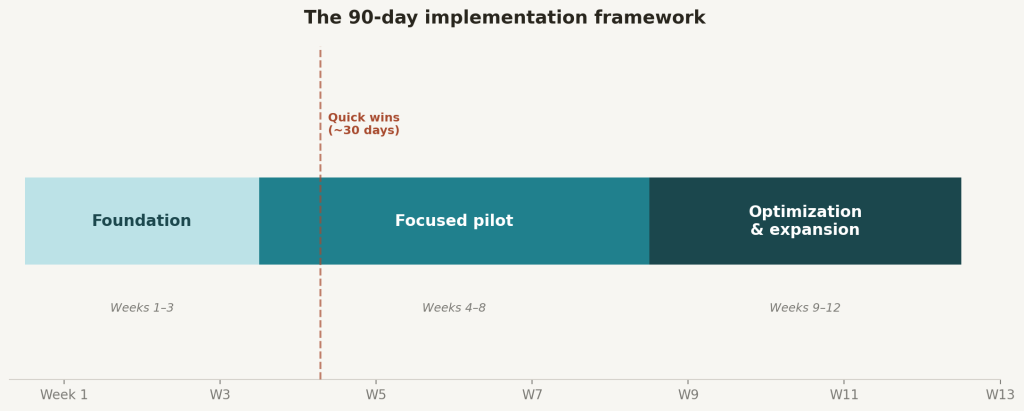
The 90-day implementation framework breaks down into three blocks: weeks 1 to 3 for foundation, weeks 4 to 8 for a focused pilot, and weeks 9 to 12 for optimization and expansion. Quick wins typically show up within the first 30 days, 5 to 10 hours per week saved from automating a single workflow.
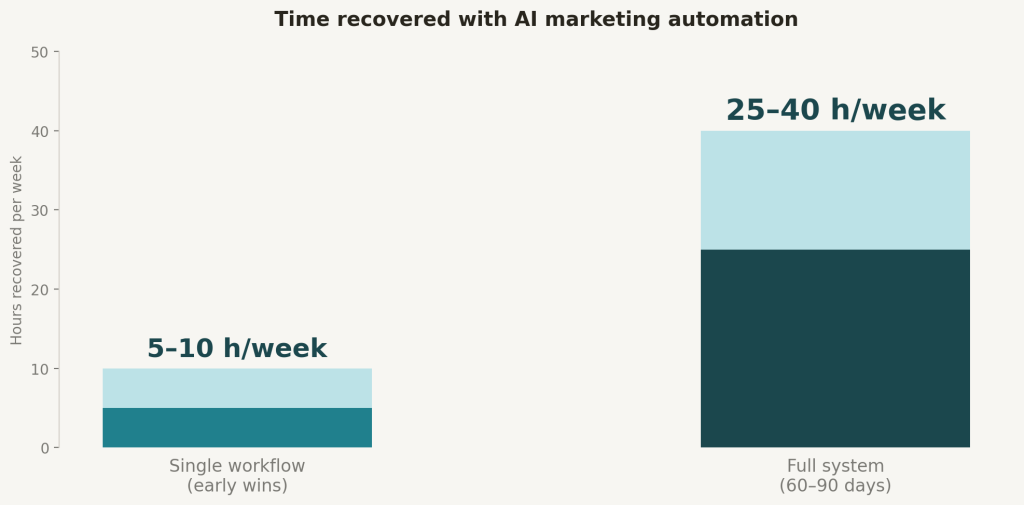
By 60 to 90 days, businesses running structured implementations report 25 to 40 hours per week recovered and measurable improvements in conversion rates and lead volume. These benchmarks vary based on pilot scope and how cleanly your existing data is organized going in.
Use cases that move the needle fastest for SMBs
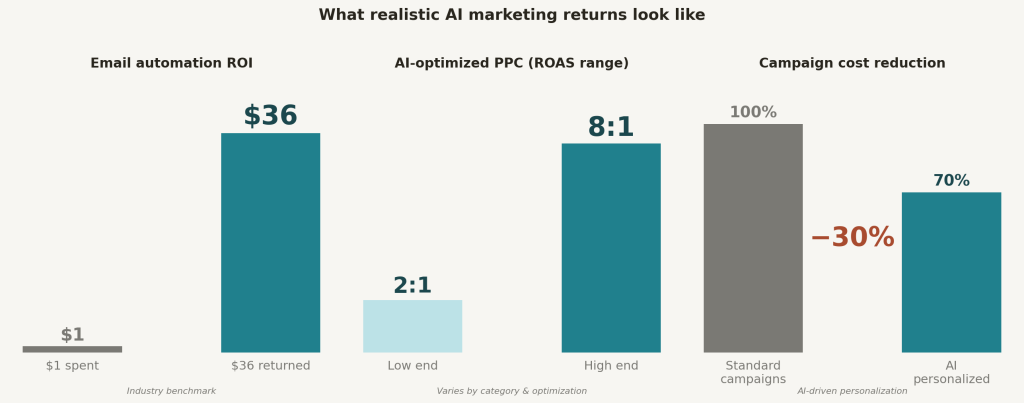
Personalization and ad optimization produce the fastest measurable ROI for small and mid-size businesses. Email automation with proper personalization delivers returns in the range of $36 per $1 spent, based on widely cited industry benchmarks. AI-optimized PPC campaigns produce 2:1 to 8:1 ROAS depending on the category, testing frequency, and landing page quality, with significant variation across industries and competitive landscapes. AI-driven personalization has been shown to cut campaign costs by roughly 30% across aggregate studies, though results depend on implementation quality and baseline data.
Lead scoring and content generation produce compounding results but on a longer timeline. They’re worth building early, but the first wins come from ad optimization and email automation. Prove the model on one thing before expanding to the rest. Businesses that try to automate everything at once typically measure nothing properly and abandon the project before the results arrive.
A simple 3-phase roadmap to get your system running
Phase 1: Audit what you have and define the gaps (weeks 1-3)
Before selecting any tools, map what you’re currently doing manually. List every marketing task completed each week and track the time spent on each. Identify the biggest drains and the highest-value activities. Evaluate your current tools, your CRM, your data quality, and where information is siloed. The goal in this phase isn’t to buy anything, it’s to understand exactly where revenue is leaking and which one or two use cases would have the highest impact if automated. For help structuring this discovery, consult resources on how to build an AI roadmap.
Set a starting budget based on your actual constraints. Most small businesses can begin with $100 to $350 per month in AI marketing tools, using entry-level tiers from platforms like HubSpot and Mailchimp to cover email automation and basic CRM, then adding paid tools as results justify the spend. Starting lean forces prioritization, which is a feature, not a compromise. If you need a reference for sensible tool selection, see a practical guide on AI marketing tools for small businesses.
Phase 2: Run a focused pilot before scaling (weeks 4-8)
Choose one use case and run a time-bound test, six to eight weeks maximum. Good starting points include email automation sequences, AI-assisted ad optimization, or a chatbot handling your most common support questions. The narrower the scope, the cleaner the measurement. Define your KPIs before the pilot starts: conversion rate, cost per lead, time saved, or response rate. Without a clean baseline, you can’t prove the results or justify expanding the system.
Phase 3: Optimize, document, then expand (weeks 9-12)
Once the pilot shows results, expand the system incrementally. Connect your tools so they share data: CRM to automation platform to ad accounts. Build dashboards that surface the metrics that matter. Establish a monthly review cadence, assign someone to own data review and act on what the system surfaces, so performance improves over time rather than drifting. Document everything, especially what didn’t work. The most expensive mistake in this phase is treating the system as something that runs itself. It learns and improves, but only with consistent human review and deliberate decisions behind it.
The KPIs that actually tell you if it’s working
Vanity metrics are easy to produce and meaningless for evaluating a system. Impressions, follower counts, and raw traffic tell you almost nothing about whether your AI marketing investment is generating returns. The metrics that matter connect directly to revenue.
Revenue and conversion metrics worth tracking
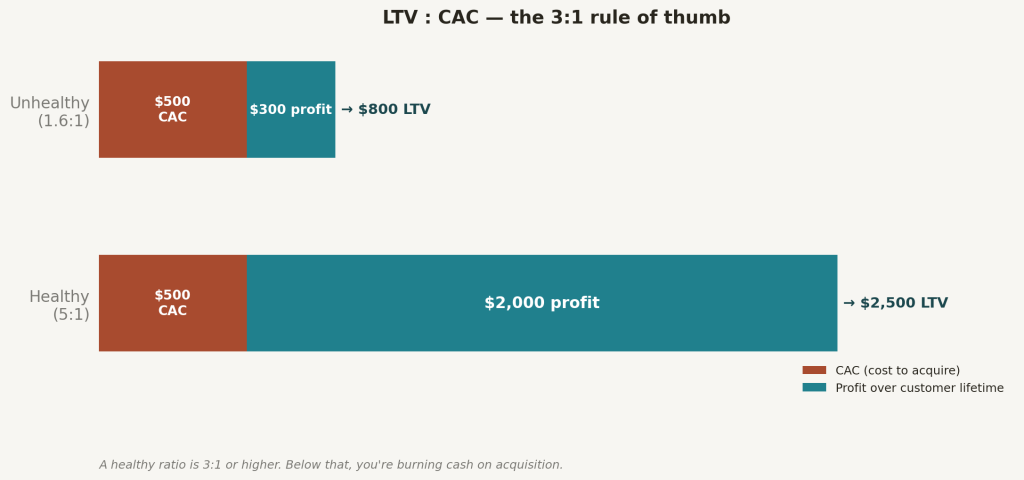
Track return on ad spend (ROAS), cost per acquisition (CPA), and lead-to-customer conversion rate as your core revenue metrics. Review CPA weekly to catch cost overruns before they compound. The most important long-term number is your LTV to CAC ratio: customer lifetime value divided by customer acquisition cost. A healthy ratio is 3:1 or higher. If you’re spending $500 to acquire a customer worth $800 over their lifetime, the system isn’t profitable yet. If you’re spending $500 to acquire a customer worth $2,500, you scale it.
Efficiency metrics that show the system is doing its job
Beyond revenue, track time saved on manual tasks, campaign launch speed compared to previous workflows, and cost savings from reduced manual reporting and external vendor fees. These metrics reveal whether the system is actually replacing effort or just adding another subscription to manage. If your team is still doing the same manual work alongside the AI tools, the system isn’t integrated, it’s just overhead.
Set a quarterly review cadence where you compare AI-optimized results directly against your pre-implementation baseline. That comparison is how you isolate what the system is actually contributing and where the next optimization opportunity sits. Predictive marketing analytics tools can automate parts of this comparison, surfacing anomalies before they become costly.
Should you build this in-house or work with an AI marketing agency?
The honest answer depends on your timeline and your current internal capabilities. The in-house path is real, but most owners don’t price it honestly.
What building in-house actually costs
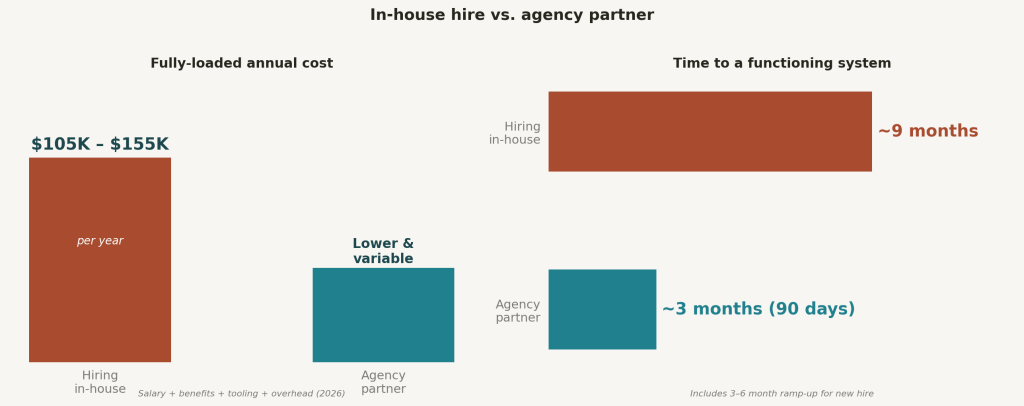
A competent AI marketing manager who can build, operate, and optimize a full system commands a fully-loaded cost of $105,000 to $155,000 per year in 2026 when you account for base salary, benefits, tools, and recruiting. That’s before the ramp-up period, which typically runs three to six months before a new hire is operating at full capacity. For businesses that need a functioning system in 90 days, not nine months, the in-house timeline is an expensive constraint.
What to look for when evaluating an AI marketing agency
Not every agency that claims to use AI runs an integrated system. Many add “AI-powered” to their service list while running the same isolated campaigns they always have. Before signing anything, get specific answers to these questions: Do they connect paid media, automation, and content into one system, or do they manage these separately? Can they show you attribution data that links their work to actual revenue, not just traffic or impressions? What does the handoff look like if you eventually bring it in-house? Agencies that can’t answer all three clearly are selling marketing, not systems.
Why Strivesync is built for this
Strivesync was built to run end-to-end systems, not isolated campaigns. The model combines custom AI agents for lead qualification, customer service, and sales automation with performance marketing across Google, Meta, LinkedIn, and TikTok, all feeding into conversion-optimized websites and content built to move people through the funnel. For businesses looking to build predictable revenue without assembling a full in-house team, this integrated approach is designed to compress timelines and consolidate costs compared to hiring for each component separately. It’s worth evaluating alongside the in-house path using the same criteria above.
The system is the strategy
The problem was never that you needed more marketing activity. It was that the activity wasn’t connected. One-off campaigns and disconnected tools don’t compound, a properly built AI marketing system does. It gets better every month as the data improves, the models learn, and the feedback loops tighten.
You have two clear paths. Build it yourself using the roadmap in this article, starting with a 90-day pilot on one high-impact use case. Or work with an agency like Strivesync that already has the infrastructure, the integrations, and a process designed to compress your timeline. Either way, the first step is the same: audit what you have, identify where revenue is leaking, and pick one use case to prove the model.
Consider this an AI marketing system explained for business owners at the decision point, the question now is which path fits your timeline and resources. Start there. Everything else follows.