
what is the best lead generation strategy for b2b companies trying to scale fast
If you’re asking what is the best lead generation strategy for B2B companies trying to scale fast, the honest answer is: it depends on your stage, but the decision matters more than most teams realize. In our experience working with scaling companies across the UAE, the problem is rarely a shortage of ideas. Teams pick the wrong channel for their current runway, then wonder why their lead flow is uneven. A rushed ad launch with no qualification layer. A content-first push when revenue targets demand meetings this quarter, not next year. These are expensive mistakes.
This is a direct comparison of four channels that actually move the needle: paid ads, organic content, AI-powered outreach, and referral systems. No buffet. No theory. Just what works when you need leads fast and how to avoid the usual tax of trial and error. At Strivesync, we run these plays for B2B clients across the Gulf, so the numbers here come from the field, not a slide deck.
The core idea is simple: match the channel to your runway, your resources, and your ICP, then layer with intent and qualification. Do that and your growth compounding starts sooner and costs less.
1. Why most B2B teams pick the wrong channel first
The speed vs. sustainability trap
Fast channels like paid and outbound create leads now, but they burn cash if you stop feeding them. Slow channels like SEO and organic content compound, but they will not save a missed quarter. Most teams try to do both at once with half a budget and split focus, then neither works well enough to matter. As a guideline, validated by what we see consistently with growth-mode clients, focusing your primary bet for 90 days and backing it with a qualification layer gives you cleaner signal and better results than splitting attention across four channels simultaneously.
Treat secondary channels as support, not equal priorities. That is how you avoid scattering spend and attention.
How growth stage determines which channel wins
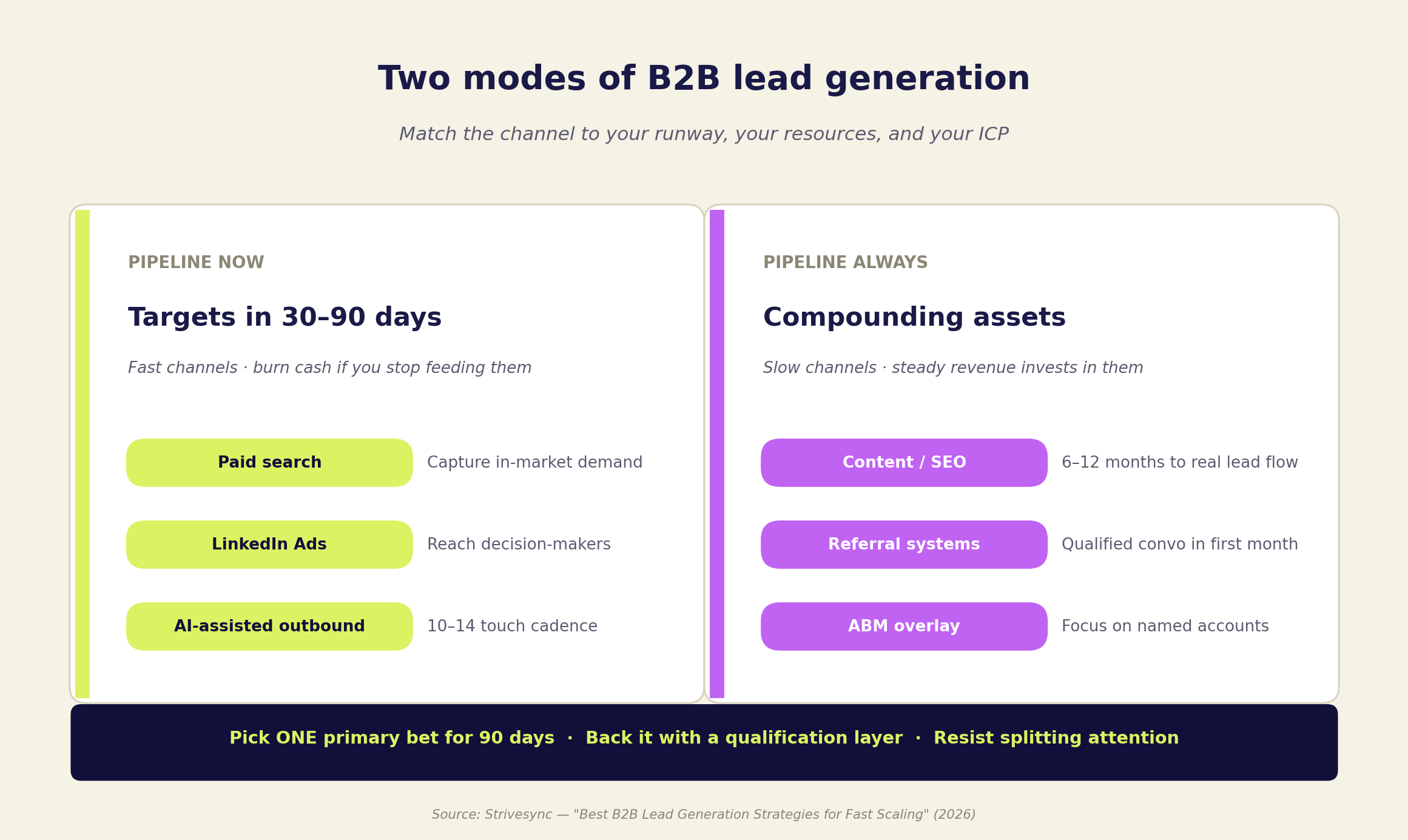 There are two modes. “Pipeline now” is for teams with targets in the next 30 to 90 days. “Pipeline always” is for teams with steady revenue who can invest in compounding assets. Paid search, LinkedIn Ads, and AI-assisted outbound win “now.” Content and referral systems win “always,” then amplify everything else once the engine is turning.
Account-based marketing sits across both. It enforces focus on named accounts, aligns SDR sequencing, and keeps your dollars in front of buying committees. Channel selection is a strategy decision, not a tactic menu, and getting it wrong is where most scaling companies lose their first three months.
2. Paid ads deliver the fastest lead flow, but precision is everything
Google Search vs. LinkedIn Ads: different intent, different use case
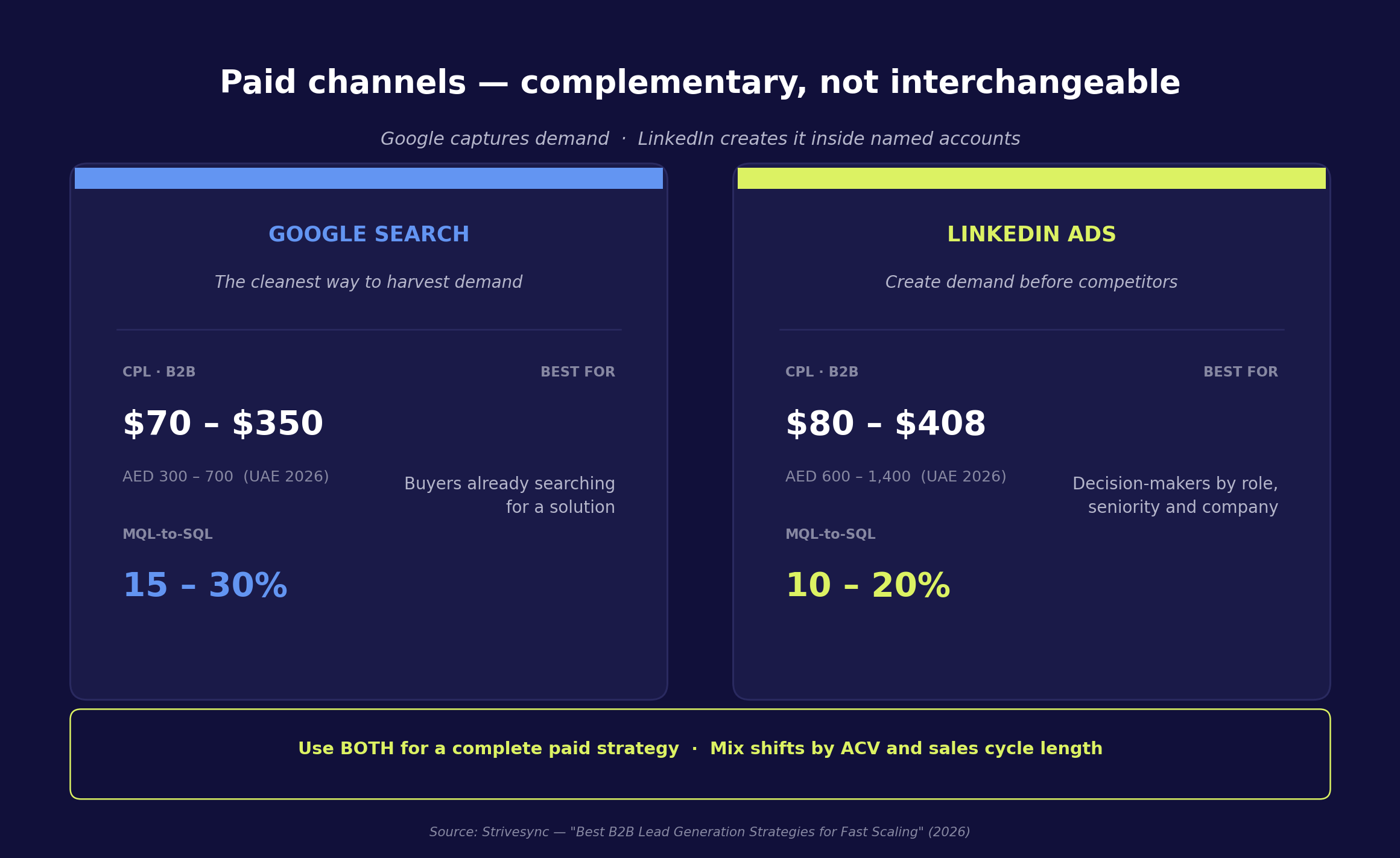 Google captures buyers already in market. They are searching for a solution, which makes it the cleanest way to harvest demand. LinkedIn reaches decision-makers by role, seniority, and company even when they are not actively searching. That is how you create demand inside named accounts before a competitor does.
Use both for a complete paid strategy: Google for capture, LinkedIn for creation and coverage of the buying committee. The mix shifts by ACV and sales cycle length, but they are complementary, not interchangeable. For a practical breakdown of strengths and trade-offs between the platforms, see this Google Ads vs LinkedIn Ads comparison.
CPL and MQL benchmarks you should actually plan against
Plan against realistic ranges, not best-case anecdotes. Across B2B, LinkedIn Ads typically land between $80 and $408 CPL with 10, 20% converting to SQLs. Google Search generally runs $70, $350 CPL with SQL rates of 15, 30%. These ranges reflect industry benchmarks across multiple studies and vary by industry, targeting quality, and what happens after the click. For UAE campaigns in 2026, we budget at AED 600, 1,400 CPL on LinkedIn and AED 300, 700 on Google for decision-maker targeting.
If your CPL is higher, fix the offer and landing experience before blaming the channel. If your SQL rate is low, fix qualification before scaling spend. For aggregated industry context you can compare against published B2B lead benchmarks.
The qualification problem that kills paid ROI
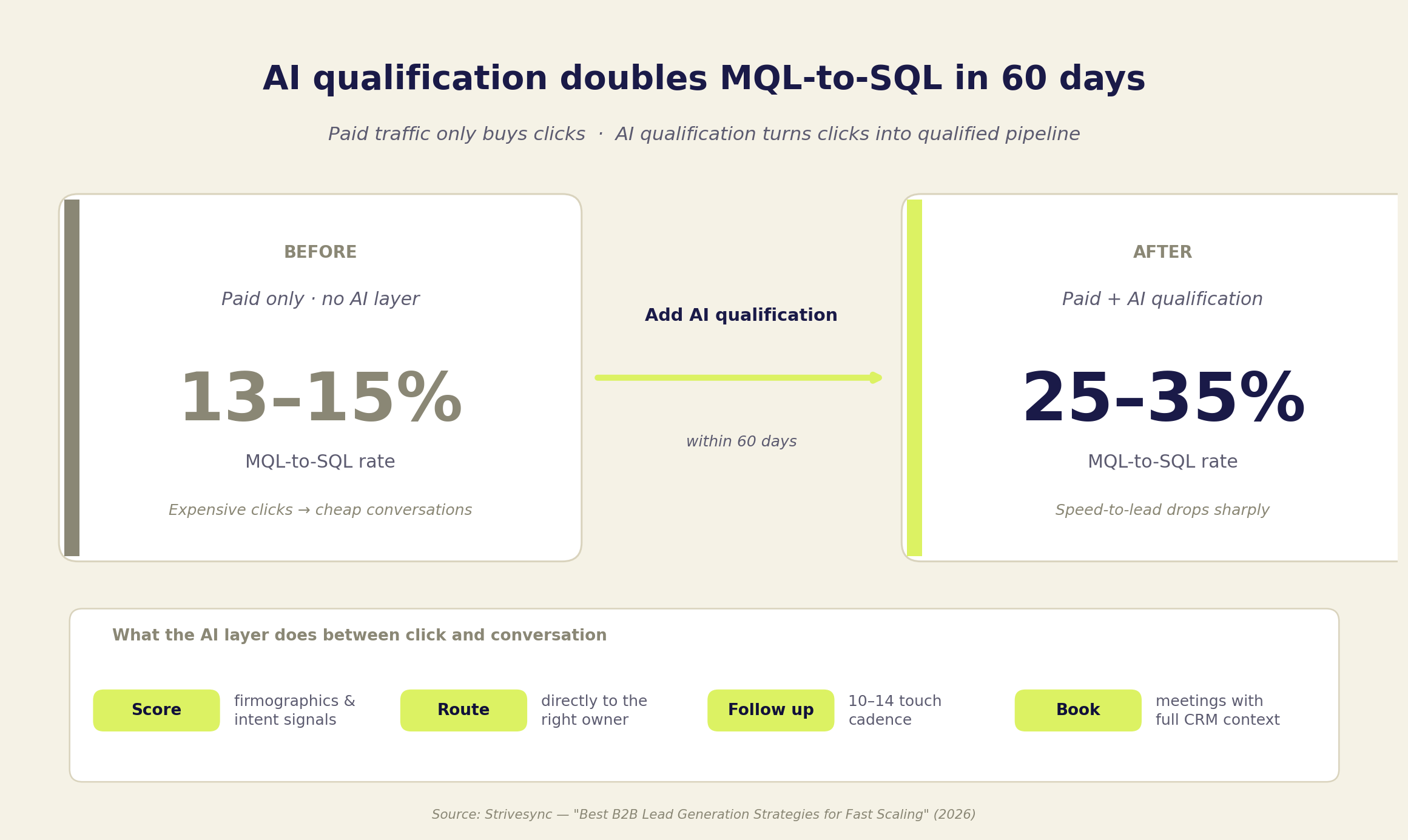 Ads without a downstream filter turn expensive clicks into cheap conversations that go nowhere. You need a scoring model, an AI qualifier, or a disciplined discovery flow to protect sales time. Otherwise your cost per opportunity spikes even if CPL looks fine on paper. Teams that add AI qualification to paid campaigns typically see MQL-to-SQL rates move from the 13, 15% range toward 25, 35% within 60 days, a shift we observe consistently across our UAE client base. Speed-to-lead also drops, which matters. Clicks do not build revenue. Qualified conversations do.
3. Organic content is a long-term asset, not an emergency lever
The real timeline for SEO-driven B2B lead flow
If you are starting from low domain authority, expect 3, 6 months for real movement and 6, 12 months for consistent lead flow. Some competitive markets take 12, 18 months. That is fine for a “pipeline always” plan, but it will not fix a shortfall this quarter. Content is an asset class that compounds when you publish consistently around buyer problems and comparison intent, not a growth-focused lead gen strategy for teams that need results inside 60 days. For a practical playbook on timelines and priorities for B2B search, see this B2B SEO guide.
Where content earns its place in the mix
Content shines in the mid-funnel. It warms prospects already in nurture, gives outbound campaigns proof to push, and improves win rates by educating buying committees before your sales team ever gets on the phone. Use case studies, deep problem explainers, and comparison pages to support live deals and remarketing sequences.
Treat this as part of your demand generation playbook. When paired with paid and outbound, content accelerates deals and reduces perceived risk. On its own, it rarely builds a qualified lead flow in 60, 90 days.
4. AI-powered outreach: removing the manual bottleneck that limits scale
Why traditional outbound breaks down at scale
Well-run SDR teams can hit 25, 40% MQL-to-SQL when the list is tight and the offer is relevant. The ceiling is volume and consistency. Human reps face real bandwidth limits, industry research on sales rep capacity consistently points to quality degrading as daily touch volume climbs, making it hard to sustain both reach and relevance simultaneously. Outbound prospecting and sequencing works, then stalls on human bandwidth. That is the bottleneck AI removes, not by spamming more, but by keeping quality steady at a higher tempo.
AI qualification: where the real pipeline leverage shows up
An AI layer that scores, routes, and follows up turns interest into meetings while filtering out noise. At Strivesync, our AI qualification system sits between the ad click and the sales conversation for UAE B2B clients. It screens on firmographics and intent signals, handles first replies across email and LinkedIn, books meetings directly, and hands over full context inside your CRM, reducing manual handoffs and compressing time-to-first-meeting. This aligns naturally with an ABM motion: run contact-level ads, trigger SDR follow-up when named contacts engage, and let AI maintain the 10, 14 touch cadence that busy teams cannot sustain manually. The result is fewer dropped leads, faster first meetings, and a cleaner opportunity flow.
5. Referral and partner systems: the highest-converting channel nobody builds first
Why referral leads outperform every other channel on conversion
Referral and partner-led leads convert faster, close at higher rates, and churn less. They arrive with trust you cannot buy through ad spend. When layered on top of a working acquisition engine, they lift overall lead quality and win rates without inflating media costs. Referrals are ROI-rich but activation-poor, and many teams leave this channel almost entirely untouched, waiting passively for introductions that never come. That is a significant missed opportunity. For practical frameworks and evidence on referral impact, see this B2B referral marketing overview.
How to activate referrals faster than most companies expect
You do not need a full partner program to start generating results. A focused, milestone-based approach can produce qualified conversations within the first month. Start small, keep it personal, and pay on qualified outcomes, not raw introductions.
-
- Identify 10, 15 past clients with strong outcomes and genuine advocacy. Ask them personally, not via a mass email.
- Offer a dual-sided incentive with payout tied to a qualified meeting or signed engagement.
- Run a short three-touch cadence with a trackable link and clear instructions.
This structure fits long B2B sales cycles and keeps quality high. It is repeatable and straightforward to expand once the first results come in. These pipeline acceleration tactics are often the fastest wins a growth-mode company overlooks.
6. The channel mix that builds predictable lead flow without the trial-and-error tax
Choosing the best lead generation strategy for B2B companies trying to scale fast: a 30/60/90 day approach
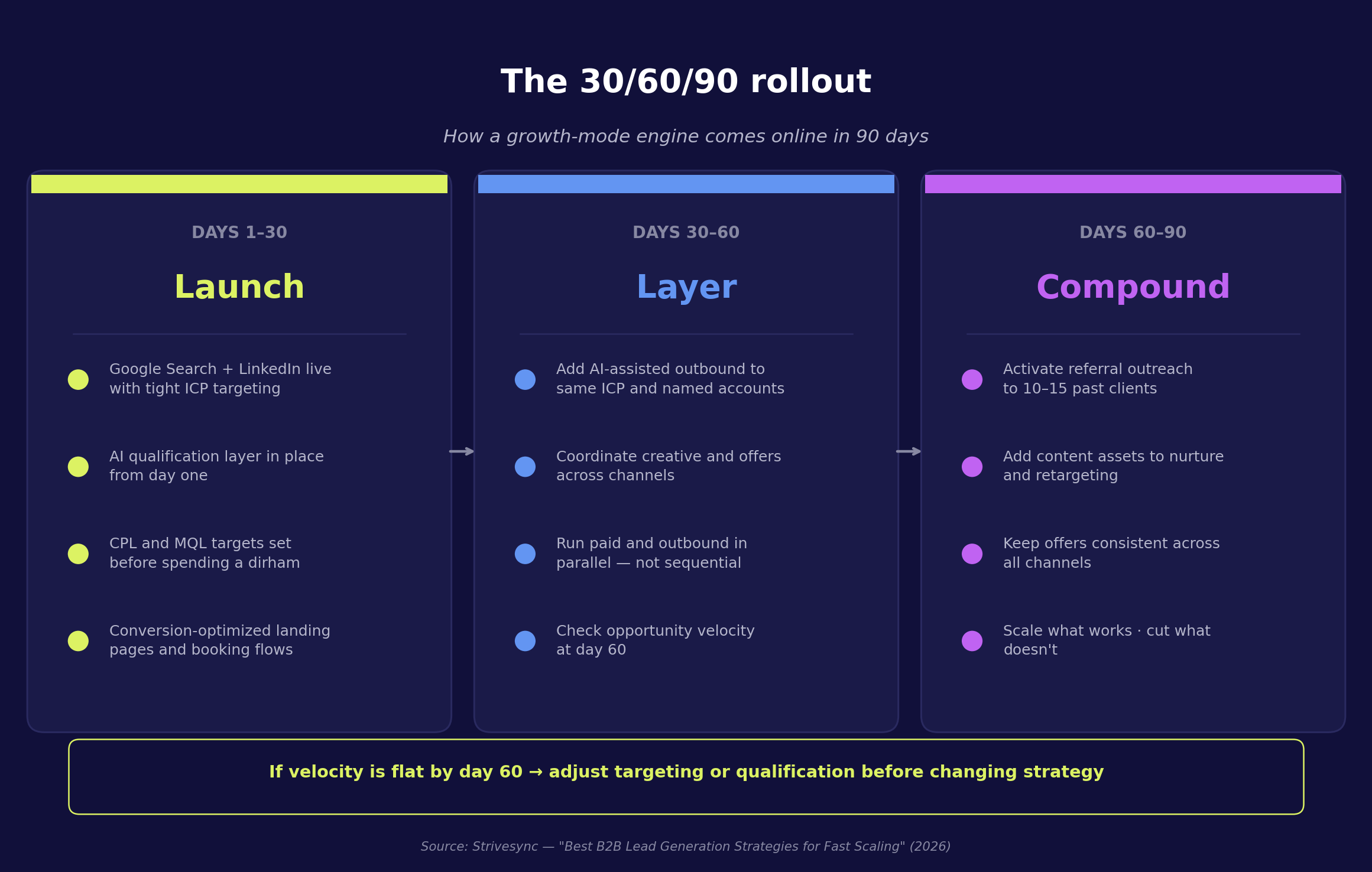
The timing below is a practical starting framework. Adjust based on your ACV, sales cycle length, and available budget, but the sequencing logic holds across most B2B contexts.
-
- Days 1, 30: Launch Google Search and LinkedIn with tight ICP targeting and an AI qualification layer in place. Set CPL and MQL targets before spending a dirham. Build conversion-optimized landing pages and booking flows.
- Days 30, 60: Layer AI-assisted outbound to the same ICP and named accounts your paid campaigns are validating. Coordinate creative and offers. Run parallel, not sequential.
- Days 60, 90: Activate referral outreach to past clients. Add content assets to nurture sequences and retargeting. Keep offers consistent across all channels.
The KPIs that tell you if the mix is working
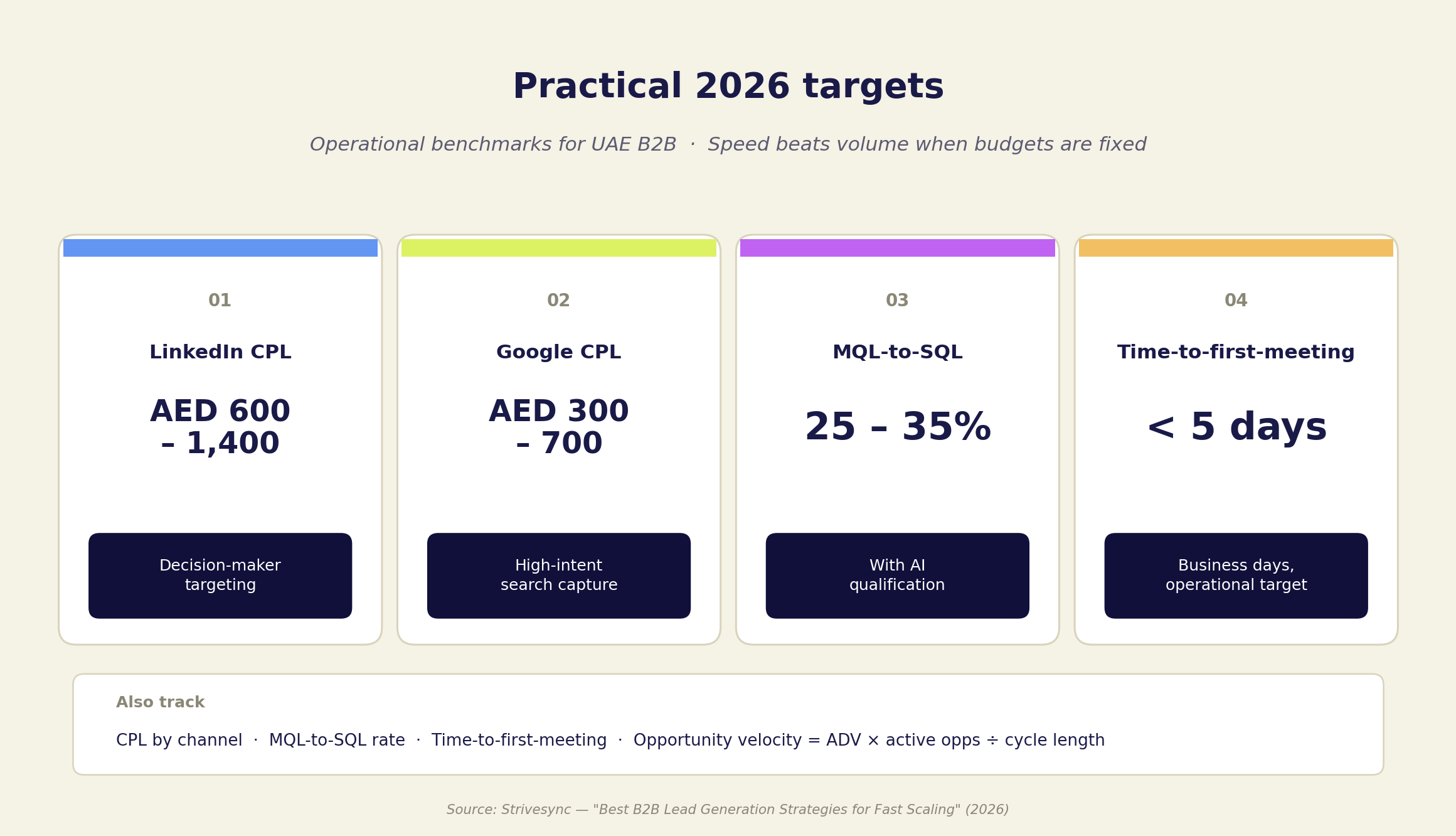
Track CPL by channel, MQL-to-SQL rate, time-to-first-meeting, and opportunity velocity. Opportunity velocity is your reality check: average deal value multiplied by number of active opportunities, divided by average sales cycle length. If velocity is flat by day 60, adjust targeting or the qualification layer before you change the entire strategy.
Practical targets for 2026: LinkedIn CPL AED 600, 1,400, Google CPL AED 300, 700, MQL-to-SQL at 25, 35% with AI qualification, and time-to-first-meeting under 5 business days (a target we use as an operational benchmark, not a universal guarantee). Speed beats volume when budgets are fixed.
Why UAE B2B companies work with Strivesync to compress this timeline
Testing four channels independently is slow and expensive. Strivesync runs Google and LinkedIn with AI qualification from day one, integrates directly with your CRM, and deploys a B2B SDR playbook calibrated to your ACV. You get a working system built for your stage, not a list of tools to figure out on your own.
We build scalable B2B lead generation as an integrated engine. Paid captures and creates demand, AI qualifies and books, content and referrals lift conversion rates, and ABM keeps focus on the accounts that matter most. The 30/60/90 structure above is how we onboard growth-mode clients who need a lead flow now, not a six-month roadmap.
Conclusion: What is the best lead generation strategy for B2B companies trying to scale fast?
The answer is the strategy matched to your stage, timeline, and capacity. Fast growth comes from picking the right primary channel, adding an AI qualification layer, and resisting the urge to run four experiments at once. Content and referrals then make the whole system stronger over time.
Paid plus AI qualification is the fastest path to qualified lead flow in growth mode. Trial and error is the most expensive way to learn that. If you are a UAE B2B company ready to skip the experimentation phase, Strivesync has the data, the playbooks, and the infrastructure to get you moving. Book a strategy call and we will show you exactly where to start.