
Most teams install a chatbot and check the automation box. But they haven’t automated anything that matters. A chatbot answers questions. Custom AI agents take action, remember context, touch your systems, and work toward a goal without hand-holding.
Generic tools create the illusion of automation. They reply, then stall at the first real task, unable to call your APIs, update your CRM, or make a judgment call. Custom AI agents are different. They are purpose-built, autonomous systems trained on your process, connected to your stack, and measured against outcomes you care about.
We build and deploy these agents for growing businesses at Strivesync. What follows is the plain-English version of how they work, what they can do, how to build one, and why they outperform off-the-shelf bots. You will leave with a shortlist of platforms, a build-and-deploy checklist, starter templates, and a governance plan for a working prototype.
What a custom AI agent actually is
How it differs from a regular chatbot
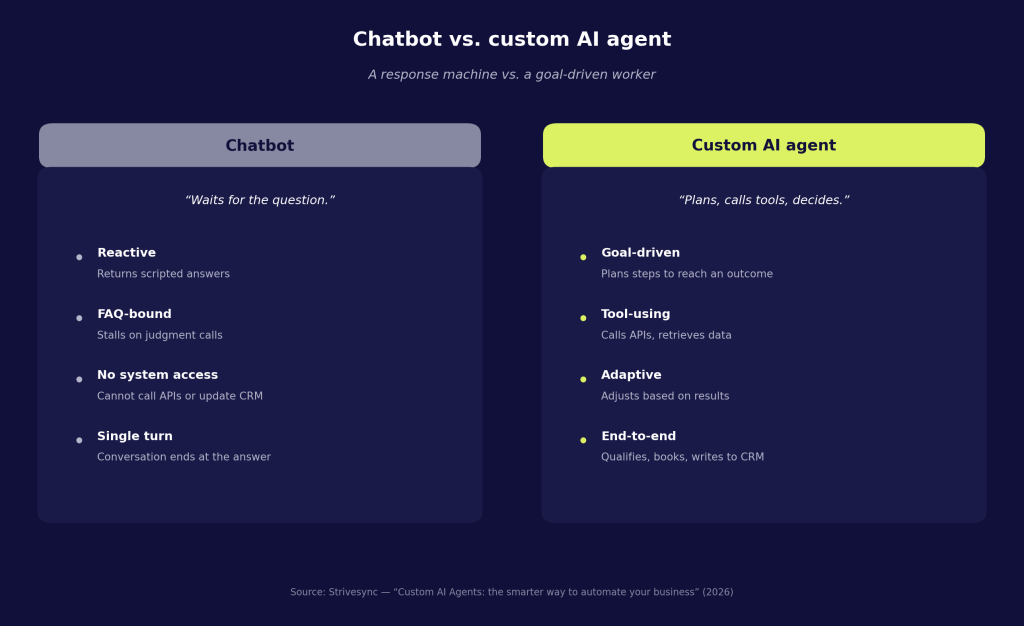
A chatbot is a response machine. It waits for a question and returns an answer, usually a scripted line or a template. It handles FAQs well enough, then runs out of road the moment judgment or system access is required.
A custom agent is goal-driven. It plans a sequence of steps, calls tools, retrieves data, makes decisions, and adapts based on results. In business terms, a chatbot can recite your pricing. An agent can qualify the lead, check your calendar, write a clean CRM record, and book the meeting.
The anatomy of a real agent
Production agents commonly include four components. First, a language model handles reasoning and planning. Second, tools give it hands: APIs for your CRM, calendar, email, databases, and payment gateways, scoped to only what the agent needs.
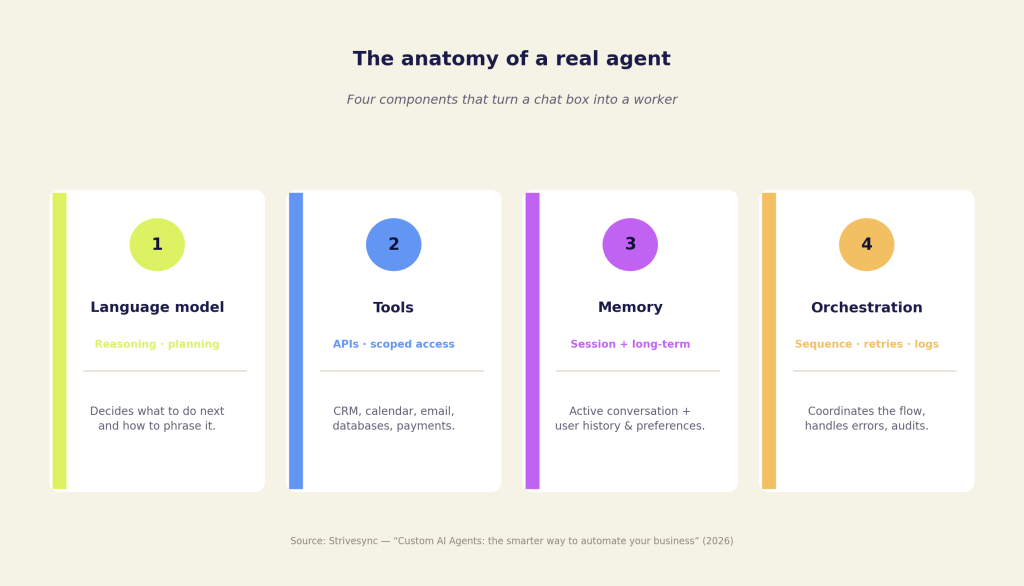
Third, memory keeps context, short-term session memory for the active conversation, long-term memory for preferences, history, and knowledge. Fourth, an orchestration layer coordinates the sequence, handles retries, and logs every decision. That orchestration layer is what turns a clever demo into a dependable worker.
What you can train a custom agent to do
Sales qualification and lead filtering
Custom AI agents can screen inbound leads by asking qualifying questions, scoring responses, and routing high-intent prospects to sales while cooling off the rest with targeted follow-up. You define the criteria and systems. The agent executes with a consistency you can measure.
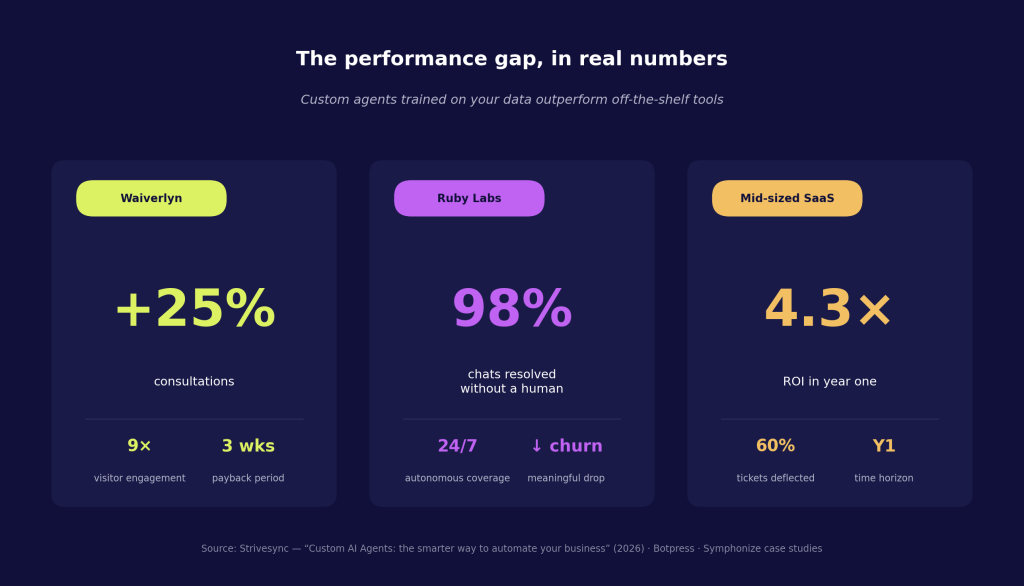
Results tend to be immediate. In one documented rollout, Waiverlyn saw a 25 percent lift in consultations and 9x visitor engagement, with the agent paying for itself in three weeks (Botpress/Waiverlyn case study). For SMBs, replacing manual triage with an always-on qualifier is one of the highest-ROI automations you can ship.
Customer service, appointment booking, and internal workflows
Support agents resolve 60 to 98 percent of routine queries, escalate cleanly, and maintain conversation memory across sessions. Ruby Labs reported 98 percent of chats resolved without a human and a meaningful reduction in churn, measured across a sustained observation period with clearly defined resolution criteria. That is not chat. That is a system absorbing volume.
Appointment booking becomes a closed loop. The agent checks availability, confirms details, sends reminders, and updates records automatically. Internal workflows benefit the same way: routing requests, summarizing documents, triggering follow-ups, and moving data between systems. Set the goal, then let the agent execute.
How custom AI agents are built
Choosing a platform that fits your needs
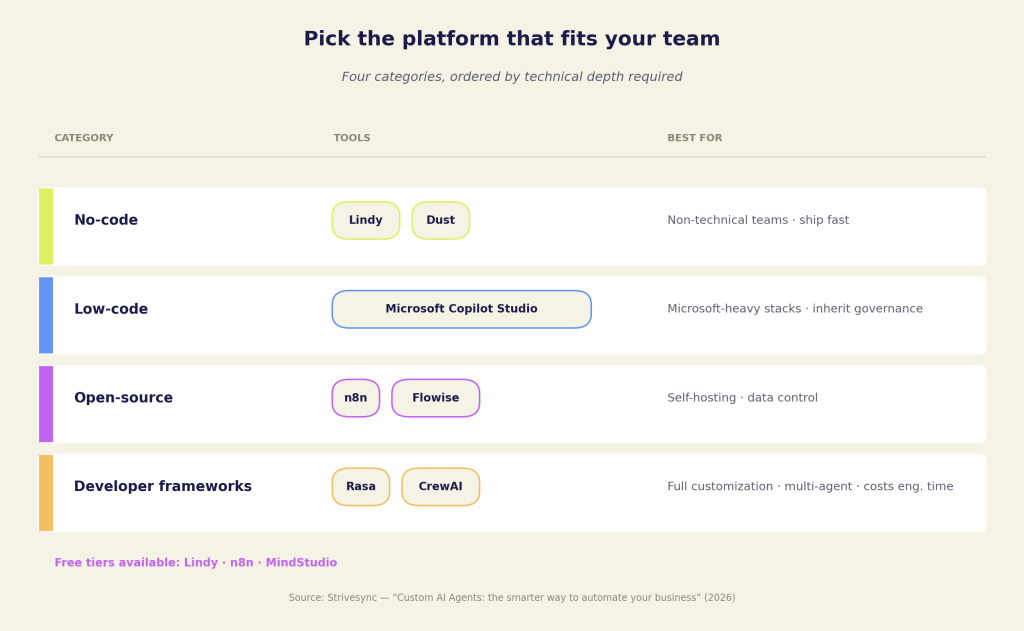
Pick from four categories and match the choice to your team, not to a glossy feature list. No-code builders like Lindy and Dust help non-technical teams ship fast. Low-code options like Microsoft Copilot Studio slot into Microsoft-heavy stacks and inherit your existing governance.
Open-source tools such as n8n and Flowise are the right call when you need self-hosting and data control. Developer frameworks like Rasa and CrewAI unlock full customization and multi-agent systems, at the cost of engineering time. Many platforms offer free tiers to start, Lindy, n8n, and MindStudio among them, though enterprise features and data volume can add costs as you scale. Testing your core use case before committing is genuinely low risk.
The architecture behind a production-ready agent
Four design decisions separate a working agent from a demo. First, scope tool access to only what the agent needs. Second, design memory deliberately, split session context from long-term facts and user preferences.
Third, choose an orchestration pattern: a single agent with tool routing works for narrow tasks; multi-agent delegation suits complex sequences and review workflows. Fourth, separate your dev, test, and production environments. A production agent must handle edge cases, resume after interruptions, and log every step for audit. This is agent orchestration, not a chat wrapper, and it is the difference between a system you trust and one that creates new problems.
Training custom AI agents: starter workflows and templates
These templates give you a working foundation rather than a blank page:
- n8n AI Agent Chat: a conversational agent with tool calls and simple memory, good for support pilots.
- n8n “Build Your First AI Agent”: a guided agent that uses weather or news tools, easy to swap for your own APIs.
- MindStudio templates: no-code customer support or lead gen agents you can customize with your data.
- OpenAI Assistants quickstart: code-first agents with threads, function calling, and retrieval for domain knowledge.
Why custom-built agents deliver results generic tools cannot match
The performance gap backed by real numbers
Numbers tell the story. A mid-sized SaaS company saw 4.3x ROI in year one from a custom support agent that deflected 60 percent of tickets (Symphonize case study). Ruby Labs resolved 98 percent of chats without human intervention. Waiverlyn increased consultations by 25 percent and boosted engagement 9x.
Generic chatbots struggle because they are built for the average workflow and light integrations. They handle a narrow slice of interactions and break under real conditions. Your process is not average, so average tools leave money on the table.
What off-the-shelf tools always miss
They do not know your product, your qualification rules, your CRM schema, your voice, or your segments. They are not connected tightly to your systems, so data dies in the conversation instead of feeding your business.
Custom AI agents flip that. They train on your data, speak in your tone, hit your APIs, and follow your workflow constraints. The result is fewer escalations, higher conversion, and cleaner data flowing into every downstream system. That is not a feature gap. It is a capability gap.
Deploying your agent without creating new problems
Security and data governance basics you cannot skip
Treat agents like users who can act, because that is exactly what they are. Governance controls do not just slow you down later; skipping them opens real liability. Skipping least-privilege access alone can expose records far outside the agent’s intended scope.
- Least-privilege access: give the agent only the tools and records it needs, nothing more.
- Comprehensive action logging: record inputs, outputs, tools used, and decisions for every step.
- Human-in-the-loop for high-risk actions: require approvals for bulk emails, record deletions, or permission changes.
Apply data minimization. Set session limits, wipe stale context, and encrypt data in transit and at rest. DIY deployments that skip these controls routinely face governance gaps that slow scaling and create compliance exposure. Good governance is what lets you move fast without breaking trust.
When to build in-house and when to bring in a team
Build in-house when you have a developer, a tight scope, and a single system to integrate. Platform and data readiness shape the timeline more than most people expect: a scoped sales qualifier typically takes 5 to 7 days on modern no-code platforms, while deeper service automation with CRM integration and thorough testing runs a few weeks. Custom builds on developer frameworks take longer.
Bring in a team when the agent must sit inside a live marketing and sales engine with ads, content, web, and CRM stitched together. That is our lane at Strivesync. We design, train, and deploy custom agents as part of an integrated revenue system, so traffic acquisition, conversion, and automation reinforce each other instead of operating in silos.
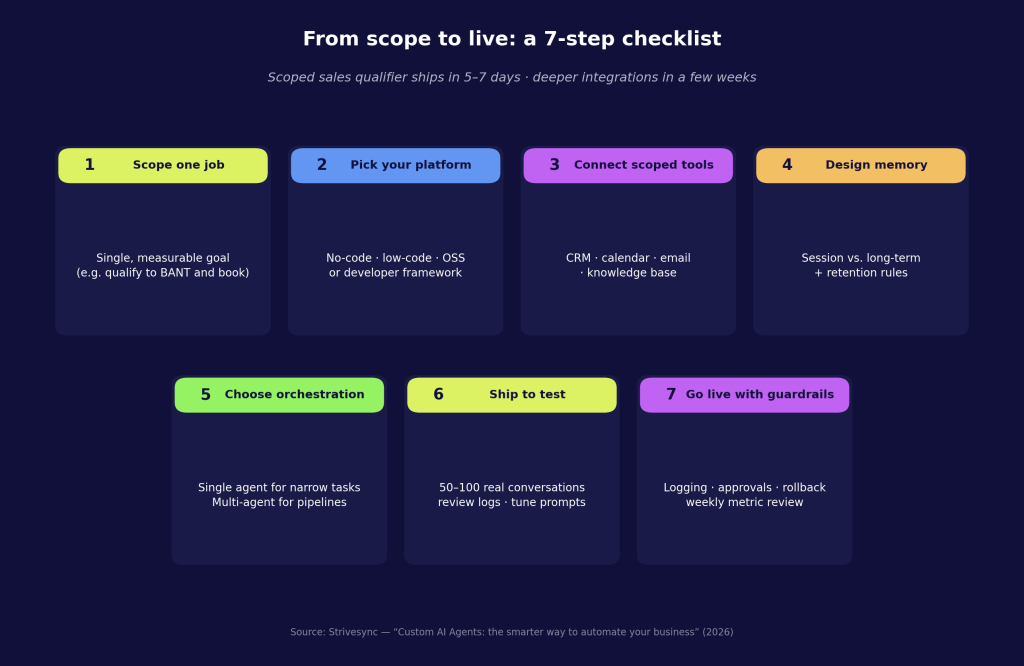
Build-and-deploy checklist you can follow this week:
- Scope one job: define a single, measurable goal like “qualify inbound demo requests to BANT and book.”
- Pick your platform: no-code for speed (Lindy, Dust), Microsoft Copilot Studio for M365, n8n or Flowise for self-hosting, Rasa or CrewAI for full control.
- Connect scoped tools: CRM write access, calendar read/write, email send on approval, and a knowledge base for answers.
- Design memory: session memory for the active thread and long-term memory for leads or customers; set retention and cleanup rules.
- Choose orchestration: single agent with tool routing for this narrow job; reserve multi-agent systems for complex pipelines later.
- Ship to test: run 50 to 100 real conversations, review logs, add guardrails, and tune prompts and scoring.
- Go live with guardrails: enable logging, approvals for high-risk actions, and a rollback plan; then review metrics weekly.
Conclusion
Custom AI agents are not a tech upgrade. They are a decision about what work humans should do and what a well-built system can do more consistently. When agents absorb the repeatable tasks, your team focuses on the exceptions that actually move revenue.
The performance gap versus generic tools is real and measurable. The build path is clearer than it looks. Use the right platform, start narrow, and lean on the templates already available. Deployment that holds up in production comes from intentional governance: least privilege, full logs, and approvals where they matter.
If you are ready to explore custom AI agents for your business, start by defining one job worth automating end to end. That single job tells you your platform, your tools, and your first success metric. If you want a partner to design, train, and connect the agent into your marketing and sales stack, Strivesync will get you from idea to impact without detours.